Strategies for Dominating a Board Game

Board games come in all different shapes and sizes. While there is no one size fits all board game there are certainly positives to be said about any game you may be interested in playing. Board games, especially ones involving strategy are good for healthy brain development.


The gameplay is beneficial in many ways including the development of your brain’s frontal lobe and well as executive function control. Many families take time out of their busy lives to have regular family game nights because it has shown to help kids in many segments of life.


Board games can benefit not only children of course, as playing games has been shown to help ward off dementia. Games help the mind stay sharp and competitive and that spirited approach can really help you not only succeed intellectually but when playing all manner of card games, video games, and online tabletop games as well.


While every game is played differently there are some strategies for playing board games that remain key no matter which game you’re playing. These ideas may not work completely for the game you enjoy playing most but the spirit of the tip should ring true in a high percentage of the games you’re bound to encounter. (Feel free to substitute the word money for army etc.)

Play By Yourself

With many games giving you the ability to play as one player, getting some practice games played is a great way to find the perfect strategy for you. When you first begin to play a new board game it can be hard to figure out what your strategy should be as you’re still trying to grasp the rules and instructions.


So once a game is introduced to you set out to play it by yourself, even if it isn’t a one-player game. Getting deeply familiar with a game will bring you a sense of reassuring comfort so you can actually focus on creating a strategy and not keeping the rules straight.


But after you have played a few times and you understand the basic goal of the game, you are going to need to develop some strategies. There’s no better way to test out your strategies than by playing yourself. Whether your game is capable of being played one player or whether you control two different pieces or units you can see what works and what doesn’t.


Obviously, if without an opponent it can be difficult to see how a technique will hold us when you’re actually playing but nevertheless, playing solo can give you a competitive advantage in you can bank the knowledge you obtained and can pull from it in different scenarios you may face.

Think Economically
Because many games incorporate randomness into the gameplay there are risks to be taken with any strategy as you can never fully predict what will happen. While strategic board game enthusiasts can run a risk assessment before making their move when a game requires a specific role of the die or a drawing a certain card, there’s always a chance things could go poorly.


Yet, being skilled in assessing the possibility and the probability of each event will still only get you so far because of the randomness during play. In this case, you should bear in mind basic economic principles, especially when playing games involving resources or funds.


Just like in real life, whoever has the most money has a significant advantage during a game and can opt to bleed the opposing players dry based solely on the fact that they control the highest cash flow. Being conservative in giving up resources/armies/money can be a really sound gaming strategy.


It’s possible to have a great strategy while being creative and brilliant but still lose based solely on the fact that you cannot finance your gaming strategy. Therefore when you are playing a game with money or resources, collecting more money is never a bad strategy to have in place.

Be Flexible

As you develop your strategy for playing games you will have to make some key choices and then execute the choices while actually playing. You can use a strategy for the entire game attempting perhaps to earn as many points as possible. You can use a strategy for a number of turns such as collecting cards to eventually make a move that will earn you points.


But rarely can you enter a game and keep the same strategy throughout the entire time of gameplay. It is one thing to create a strategy in your mind and another to execute while playing. You can commit to your goal for a time but if an opponent begins to advance to quickly it may pay off to switch to your plan B.


Don’t get caught up in other people’s strategies. If your plan is to go on the offensive then go for it. If you’re always attacking no matter what, the other players will have no choice but to retreat and will not be able to achieve their own goals within the game.


However, The offensive strategy only works if you can achieve success, since as you advance your fellow competitors will likely retreat. In some games, this can result in a cat and mouse game that will become boring very quickly. Other times playing agressively will certainly pay off. Part of the fun and excitement of a board game is never really knowing what’s going to happen.


Being too conservative, especially in wargames isn’t going to result in a fun game. It’s key to remember that while winning is great, having a fun time with your gaming companions is also one of the reasons board games are so popular. While you should typically never make a move if you won’t survive the worst result of that attack if you aren’t having fun, what’s the point?


All the strategies in the world can’t account 4 random card drawings and what your opponent will be doing. That’s why part of having a good strategy is being flexible and adaptable with your gameplay actions. you need to be able to react quickly and make contingency plans no game is ever going to develop the same way twice so you have to be able to adapt.

Conclusion
It can be hard to break into a board game community that’s new to you, maybe these people have been playing for years but it’s important to remember that while board games can bring out negative traits in our personalities, they can also help you to see the strengths you have. Board games are a great way to expand your social relationships and to exercise your brain.


The more times you play a game the better you’ll be and the larger variety of games you are familiar with will give you more strategies to fall back on. Take some risks and focus on your strategies, once you start winning you won’t want to stop.


Kriegsspiel vs Pub Battles

We have 2 Brandywine games.  A Kriegsspiel version and a Pub Battles version.  Which one is better?  How do they compare?  This post was prompted by a great question:


I have been looking at your Brandywine games in detail:  The Kriegsspiel and Pub Battles version.  Both games look fantastic.  Pub Battles seems a bit pricey.

What would you recommend between these two?

Manuel


Great question.  It depends what you are looking for.  I’ll try to summarize the advantages here:

Pub Battles:  Brandywine

  • Fast Play time.  You can setup and knock out a game in less than 1 hour.  
  • Small Map size.  Easily fits on a small table.  Easy to transport and play at a bar, park or restaurant.
  • Because the map is smaller scale, the area to the Colonial left is expanded.  This game allows the British the option to flank from either side.  In this way, I think it allows for a truer command feel by the Colonials.  They have no idea where the British will attack from.  A true sense of surprise. 
  • Canvas Map option.  The ‘pricey’ version comes with the canvas maps.  That’s what real maps from the period were made from.  They are amazing quality, durable and water resistant.  -Great for spilling drinks.  Note that this is an option.  You can get the regular paper map for only $62.66 right now.  The Kriegsspiel sets all come with paper maps.  
  • Standard 2 player format.  No Umpires needed.  You can play with up to 6 players.
  • This is the better option if you are new to the hobby or looking for a game to teach new recruits.


Kriegsspiel:  Brandywine

  • True Kriegsspiel Rules.  Fully compatible with the original Reisswitz, Prussian Kriegsspiel.  You can play this with multiplayer teams and umpires etc.
  • Pub Battles Rules option.  We ship this with Pub Battles rules.  Alternatively, this converts the game into a full blown, detailed, traditional, 2 player wargame.  Check out the Review tab here for a player report on how this works.    
  • Smaller scale.  This matches true Kriegsspiel scale but the map it huge!  It does give you more detail and finer control as far as being able to form your lines along tree lines and slopes.  Also more detail in actual contact and types of combat. 
  • This is the better option if you have time, space and are looking for a more detailed, standard type wargame. 


Brandywine Variant

Tom recently sent this in as a player’s guide and variant for our Kriegsspiel Brandywine Scenario.  It is a fantastic supplement!  Our Battalion rules allow you to fight this out as a detailed Pub Battle.  Fast, easy and very dynamic.  We need to further develop this into a whole new series!  


Every time I play the KS games reinforces the unique nature of this addition to your family of games. These games offer a completely different dynamic from the standard Pub Battles offering, capturing the flow of each battle much more effectively, and offering deep insights into the circumstances and outcomes of each modeled battle. They represent a truly new departure for your game system, and one that will, in my view, prove very attractive to both new and veteran military board gamers.

I’d like to see a more robust framework for game play in this KS series. KS Bunker Hill is better than KS Brandywine in this respect, but still doesn’t provide enough information for the players to launch into the game without a lot of additional research. 

I think this is pretty easy to fix, and have attached what I put together for KS Brandywine. This version has been refined by multiple games, and I think provides a pretty good, “stand alone” start point for purchasers of KS Brandywine.

 Thanks, Tom 


Kriegsspiel (KS) Brandywine Scenario with Pub Battles Rules (using Version 2.92 Rules)

  1. Command Additions. For the British, Cornwallis and Knyphausen, as wing commanders, act as “extra” army commanders for their respective wings, in addition to commanding directly the troops identified immediately under them on the loss rosters. Subordinate commands for Cornwallis are Mathew (Guards and Grenadier Brigades), and Grey (3rd and 4th Brigades); Donop (Hessian Brigade) is directly subordinate to Cornwallis, and activates with his headquarters. Subordinate commands for Knyphausen are Grant (1st and 2nd Brigades); Stirn (Hessian Brigade) and the three battalions of the 71st Highlanders  are directly subordinate to Knyphausen and activate with his headquarters.  Only Howe, Cornwallis and Knyphausen can roll to change turn order, for themselves or for any subordinate under their respective commands (and within command range), on a roll of 4 or less.  All commanders (except Howe, who may be activated with any British command) have a “chit” n the command cup (but see Order of Appearance, below). British elite units include all three units of the 71st Highlanders (71, 72, and 73), all British Grenadiers, and the Foot Guards.

For the Americans, Washington is the Army Commander and also commands the troops directly under the “Reserve” on the loss roster.  Subordinate commands are Sullivan (including Stephen’s and Sterling’s Divisions), Greene, and Wayne.  All commanders have a “Chit” in the command cup, but only Washington can change turn order, for himself or for any subordinate within command range, on a roll of 4 or less. Defeat numbers for the two armies are 18 for the British and 14 for the Americans. You will need to make additional commanders blocks for this, as well as “commitment” chips, which are not included in the game.

Combat ineffective numbers are 50% of infantry and cavalry units (combined) for each command according to the rosters (the three British Light Infantry battalions are included under Cornwallis for determining combat ineffective percentages).

  1. Historical Order of Appearance. Knyphausen’s command begins the game deployed on the map anywhere south of Wystar’s Ford and west of the Brandywine, with the exception of the 1st and 3rd Battalions of 71st Highlanders – 71 and 73 unit labels, respectively. These are optional units, which enter the turn following any movement by an American unit west of the Brandywine creek (these units historically were assigned to guard Howe’s baggage trains, and did not take part in the battle). Cornwallis’ wing (with Howe) enters the game map on turn one as the first units to activate, crossing the Brandywine in road column at Jeffries Ford, in the following order: Mounted Jagers, British Grenadiers, Light Infantry Brigade, Hessian Jagers, Foot Guards, Artillery, Hessian Grenadiers, 4th Brigade, 3rd Brigade, and 16th Dragoons. Chits for Cornwallis’ subordinate units are not added to the command cup until turn two.  The game ends following the end of turn ten.


  1. Light (including Jager) Infantry. Light infantry units are exempt from all command rules, and can be activated with any friendly command. Bombardment attacks against light infantry have a -1 modifier. Light infantry units have all around facing, cannot be flanked and disregard fields of fire – that is, they may advance into enemy fields of fire without moving into actual contact, and do not exert fields of fire themselves.  Spent light infantry units may not rally in an enemy field of fire, however.


  1. Light Infantry Fire Combat. During the combat phase, light infantry units that are not in actual contact with enemy units (either attacking or being attacked) can “fire” (once) at any enemy unit within one third infantry movement that is not in contact with another friendly unit (bombardment attacks likewise cannot target enemy units in contact with other friendly units). The light infantry unit rolls two dice; normal combat rules apply (including cover). After the light infantry fire is resolved, non-light lnfantry or dragoon units that are targeted by light infantry fire may return fire (regardless of target unit facing), also using two dice, but resolve their fire with an additional -1 modifier. Light infantry units firing at each other resolve their fire simultaneously, with no additional modifier.  Light infantry units that retreat from combat during the combat phase (voluntary or involuntary) cannot also fire. The three American skirmisher units are NOT treated as light infantry.


  1. Road Column. For infantry and cavalry, per the KS Brandywine Scenario Pub Battles rules, there is no movement cost to enter or leave road column. However, a unit may enter or leave road column at the beginning or the end of its turn only (NOT both). Mark a unit in road column by stacking a baggage train block on top (baggage trains are not used in the Pub Battles version). For especially long columns, stack a baggage train marker on the first unit in the road column. Artillery DOES expend 1/3 movement cost to limber OR unlimber, and can do so more than once – for example, limber, move one third move, and then unlimber. Limbered artillery is always considered to be in road column.


  1. Stacking and the “combined Division”. There is no “stacking” in the Pub Battles version. Supporting units are placed adjacent to the rear of the supported unit, just as in normal Pub Battles games. The only “stacking” that occurs is by column markers on top of the lead unit in the column. Disregard the “combined Division” rules in the KS Scenario addendum. Treat Infantry, artillery and cavalry blocks just like any infantry, artillery or cavalry block in pub battles, moving and fighting independently.


  1. Terrain Notes. Fields of Fire remain 1/3 Foot movement, and Artillery Ranges remain one foot move (about three quarters of a mile). Disregard the “bridge / ford” rule – movement across a bridge or ford still reduces movement, if the unit is not in road column.


  1. Tracking losses and “Combat Ineffective” status. The larger numbers of physically smaller unit blocks makes determining combat ineffective status a bit of a chore. The easiest way to do this is to use the Loss Rosters. Simply move destroyed units to the loss roster, on top of their unit strength. You will be able to see at a glance which commands have become combat ineffective as the game progresses.


  1. OPTIONAL Movement Rules. At the much larger 1:8000 scale, and with smaller (one half inch) blocks, the original Pub Battles Terrain rules are simple and easy to apply. To use the original rules, apply a one third movement penalty for each terrain type. Always allow a unit to move one third movement regardless of terrain (except for rivers, which can still only be crossed at a ford). If a unit has already been reduced by one third, and it encounters other terrain requiring further reduction, it halts immediately.  (I strongly recommend using this rule – it takes greatest advantage of the superb Pub Battles maps, and forces the players to analyze and use terrain in the same way as the actual army commanders).


  1. Victory Conditions. Calculate victory at the end of the game: 1 point for every enemy unit destroyed, plus three points for the British if they control one of the two major roads (control=no American units within 2/3 foot move of the road).  The Americans receive one victory point if rebel losses are less than 50%.


Pub Battles Victory -50% of What?

Rules Clarification for Pub Battles


Question

You are usually defeated when you suffer 50% losses in Pub Battles.  That sounds clear but 50% of what exactly?  What if there are reinforcements that have not yet arrived on the field?  Do they count?  Is it 50% of your entire army combined or 50% of just the forces in play on the field so far?

Answer

Count only the forces in play on the field so far.  So as new reinforcements arrive, your total strength and 50% loss number goes up.  This bolster’s your army.  You can fight longer and take more losses now. 

“Who ever saw a dead cavalryman?” Gettysburg

John Mosby


To me, it’s not at all complicated to distinguish an Infantry unit from a Cavalry unit in PBs.  There’s such a thing as carrying “minimalism” too far, to the point of “bland.”  I might order a Scotch without water, but water without Scotch is simply rehydration.


We are very fortunate to have such a talented and knowledgeable group of play testers in our design team.  We have great discussions.  I often wish they were public.  This is a small example.  Just 1 email picked out of hundreds of our banter back and forth.  I hope you find it as interesting as I do!


Sorry to differ, but saying Artillery in PBs is “not an abstraction” beggars reason.  The Artillery units in PBs don’t represent 1-2 guns—I know you know this, of course—but these units also don’t represent “usual concentrations” except in the sense of portraying sections of the battlefield where Artillery is particularly focused/targeted (and at this, Artillery Range, from the physical location of the Artillery unit to the targeted unit, is still an abstraction—those guns would be firing from other in-range locations, not just in a hub-to-hub line of cannon).


Troops were very accustomed to Artillery “falling silent and withdrawing.”  It happened all the time.  Batteries redeployed at the orders of the Division or Corps commander to which they were assigned; batteries withdrew when ammunition-depleted; batteries shifted location sometimes when particularly effective counterbattery fire (actually rare in the ACW; Federal batteries firing on Alexander’s concentration on Day Three were ordered to hold fire by Hancock in order to preserve rounds for the infantry attack he knew was coming) began to impact them adversely (usually in terms of a caisson exploding or an unsustainable number of horse losses in the battery).


Batteries might even just fold and fall back in the face of an attack (Infantry was very accustomed to orders to “Save the guns!”).  Such things did not disconcert any but very green troops.


Re ACW cavalry, most infantry never saw them engaged on a battlefield.  The bitter slogan “Who ever saw a dead cavalryman?” reflected not only infantry’s contempt for cavalry (especially in the Federal Army, at least up to Gettysburg) but the fact that ground-pounders rarely saw cavalry in action—they were more likely to be deployed to the infantry’s rear with orders to shoot any man who routed (there is a statue of a dismounted Federal cavalryman, kneeling with carbine at the ready, right behind the “High Water Mark” position at G’burg!  He was NOT there to personally help repulse Pickett’s Charge.)

John Buford


Reynold’s troops saw some casualty in Buford’s battle area, but understood that the troopers had bought them time to come up with tactics and with blood.  They were hardly shaken at the sight of a couple dozen troopers in their immediate front (despite the phrase “shattered brigades” in the text narrative at the end of the “Gettysburg” movie, Buford’s division had not been shattered, only wearied; they were withdrawn to Westminster to replenish ammunition, draw rations, re-shoe horses where needed and rest, and were very much involved in the pursuit after G-burg—read the account of Buford’s no-nonsense handling of a Southern spy captured between Westminster and the Potomac).

JEB Stuart

On the Southern side, Confederate infantry may have thought more highly of Jeb Stuart for the reputation he had built, but were singularly unimpressed with his Gettysburg Campaign wagon-train-raiding shenanigans.  But they were not shaken by his defeat by Custer on the East Cavalry Field, they didn’t even see it—it was out of sight and virtually out of the hearing even of the left-flank Confederate infantry.


The destruction of Pickett’s Division and failures of Pettigrew’s and Trimble’s infantry, coming after the “flat finish” of the second-day Confederate infantry attacks, are what really shook the ANV (and its commander) as never before.


This last not to undermine your statements vs friendly dragoons in the AWI, but out of genuine curiosity: where are some sources I could read re Infantry liking “having dragoons around” and the “infantry line” becoming unnerved at the dragoons’ absence? 


by Barry Kendall

Alfred Pleasonton

Commander MIA

Here is an interesting Kriegsspiel situation.  You never see this in regular wargames.  What if you lose contact with your commander?  What should you do? 


Our campaign began with our army dispersed wide over a province.  The enemy declared war and intell reports that a large enemy army has crossed the border and is heading our direction.


I received no starting orders.  Of my own initiative, I moved my Corps to a central location, in anticipation of a concentration.  I immediately sent a report to the Army commander informing him of my intent and planned march. 

I have been marching and fighting now for a week.  I have destroyed 1 enemy Corps and am about to attack and destroy a second.  I have been sending 1 Sit Rep every night to my Army commander.  Reporting on my daily events, enemy positions and strength, and my intentions for my next maneuvers. 


What is the response from the Army commander?  Silence.  I have yet to receive any orders or messages for the entire game.  What does this mean?  What should I do now?  What would you do?  Have I over stepped my bounds?  Am I going way too far?  Am I on the right track? 


We usually think of silence as peaceful and serene.  Here I find it fearsome and disturbing.    

Gettysburg Replayability

I have just completed another game of Gettysburg,  and this was a Union Major Victory (Confederate concede on turn 7 of Day 2 with ten blocks lost).

First off, for simplicity purposes, I count all blocks no matter the type. In this particular game all losses were infantry and both elites were lost.

I find that Gettysburg has a certain flow. On day 1, Lee has a shot at a major Victory. This is a little misleading as he actually has the smaller force for the first half of the day, and not much more than the Union by the end of the day.

Lee may have a chance on the first few turns of Day 2, but somewhere the tide turns. When that has happened is the critical point of the game, and the one that tests the player’s judgement.

If the South switches to the defensive a turn late, they can lose quite quickly. If they switch too soon, they might miss a chance at a major.

Switching from a desperate bid for victory, to a cool withdrawal, is such a major shift in thinking that it more frequently results in pushing too long.

Frequently,  the game then becomes very tense for the Union player, as now they hold the cards. They must push Lee over the edge without ending there themselves.

This is made tricky by approaching night. Come morning, Lee will have had a chance to recover, and Stuart will arrive!

In the best games, Lee manages to wrest initiative away from Meade, as the game see-saws back and forth.

This is why this game has so much replayability.


Mike Strand

Kriegsspiel Example

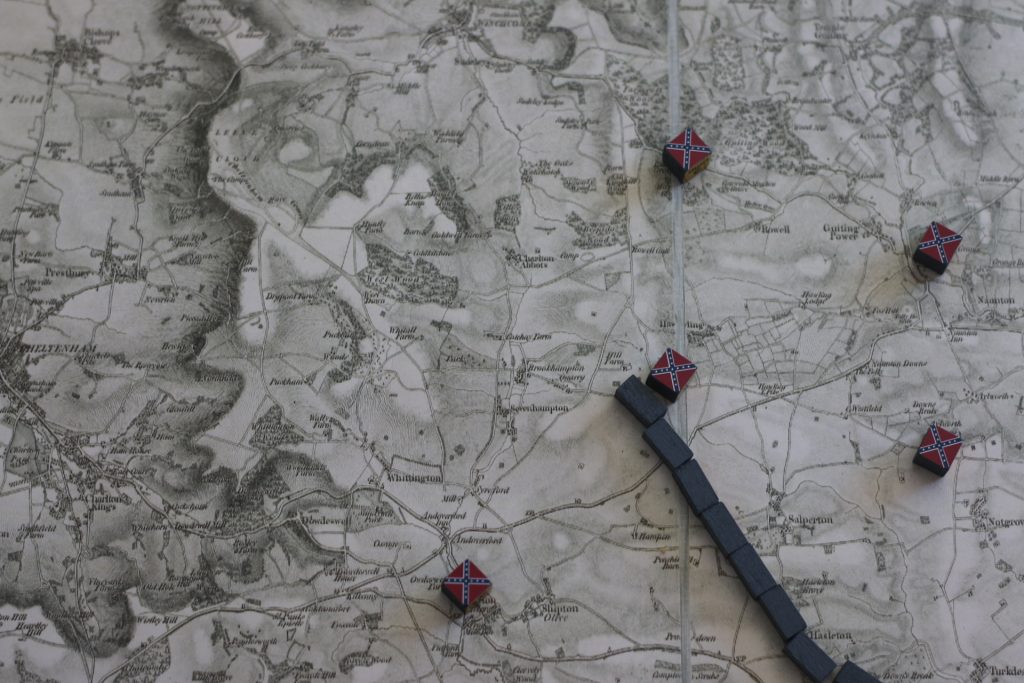
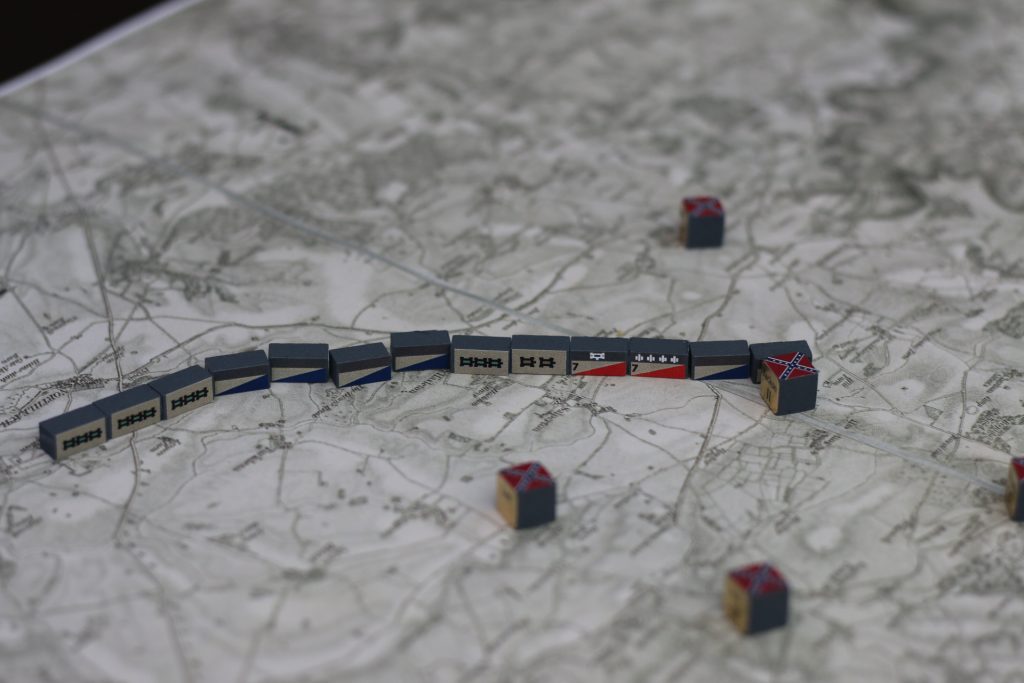
Here is a fun little example of a Kriegsspiel problem / situation.  What would you do if you were in command here?


Civil War era.  Operational scale.  Each block represents a Division of about 5,000 men.  You are in the Confederate Army of Northern Virginia.   

The Army of Northern Virginia has been marching NW for several days.  The Army of the Potomac is reportedly to the NW and is moving in your direction.  You are closing with the enemy and a battle is soon expected.  Comparative strength is unknown. 

The Army of Northern Virginia is divided into roughly 3 equal Corps.  You are in command of Jackson’s II Corps.  You are in the center.  Longstreet is to your left.  Hill is to your right.  Those little flag / HQ cubes mark your best guess as to where your friendly columns are currently.  You have marched for 3 days at a leisurely but steady pace:  5 miles per day, then stopping to forage the area for supplies and setting up camp for the night. 


You have marched 5 miles today since dawn.  It is now mid morning.  You have just halted the column and are preparing to send out foragers when you hear a fight break out to the SW of your position:  musket and canon fire.  This is likely in the vicinity of Longstreet’s Corps which is about a 2-3 miles away.   This is the first contact with the enemy. 

Map ahead. Enemy is expected to be approaching from the NW or upper left. Your LOC runs back to the SE.

Lee’s HQ is about 2-3 miles east of you. What do you do?  What are your orders?

What are the options?  What is the best move here?  Why?  Keep in mind that the clock is ticking.  Every minute you spend thinking and writing, delays your troops response.

Comment below. 

Do you need more information?  Have questions?  Ask!  I’ll provide Umpire answers.  🙂


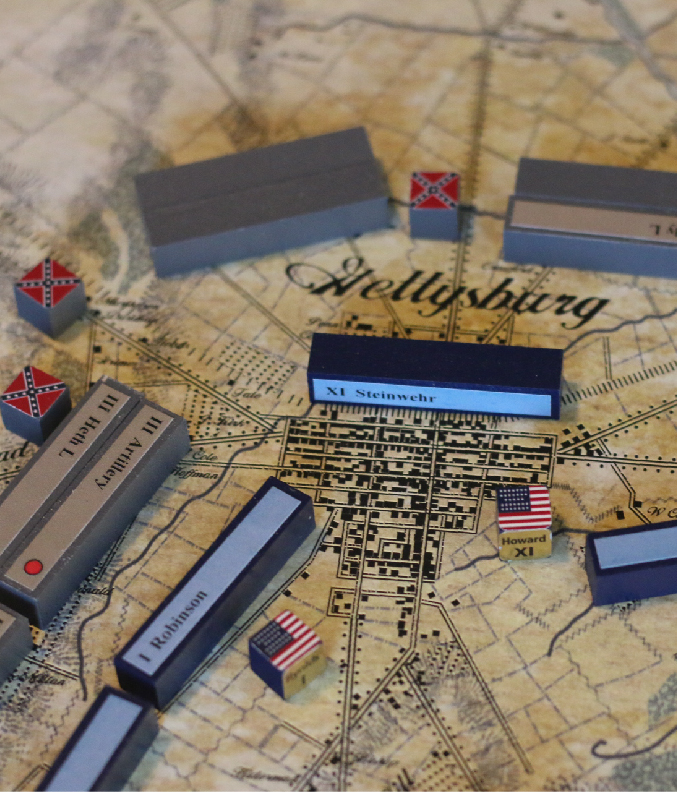
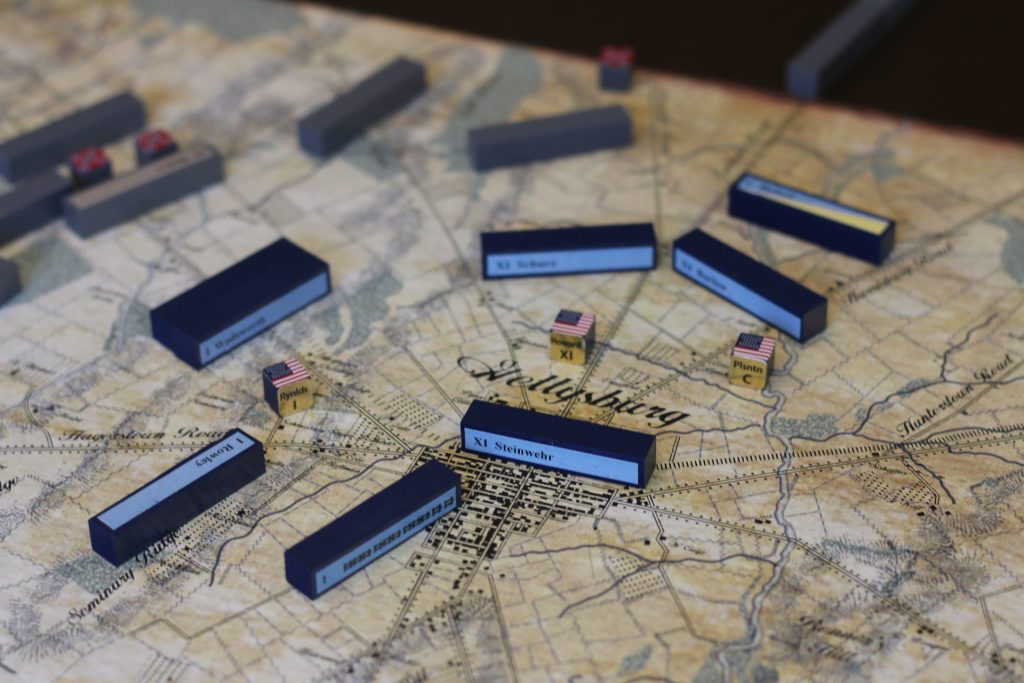
First Impressions: Pub Battles Gettysburg

So how is this new Gettysburg game?  Is it any good?  What is it like?  Here are some initial reactions from Mark:


I have been discussing ideas with Mike, but I have only played with the rules as written – and then the last couple times with the Baggage Train idea of 1 unit per Train rallying.  That rule, by the way, really improves the game for my tastes!


Overall, I enjoy the game very much.  I think it handles Day 1 as well or better than any other Gettysburg game I have played.  It unfolds in a historically plausible manner, is fast paced, and leads to plenty of solid, difficult decisions for both sides.  The PB system is responsible for a lot of that.  The random chit draw along with the ability to try and alter the draw is what makes the 1st day challenging and variable.  


That being said, the game suffers some of the same problems all Gettysburg games suffer in days 2 and 3.  There are a lot of units, both sides are very strong, and it is essentially a stalemate.  I find that in the opening turns of Day 2, there is still a feel of a good game going, with the South having an opportunity and the North just weak enough to make it exciting.  But unless heavy losses are inflicted quickly, the game tends to bog down into a game where the South is pressured to win (since I interpret the rules to mean that if you play past day 1, the only kind of victory available for the South is a Major victory by Defeating the Union through 50% losses).  The South no longer has any kind of positional or strength advantage by the second half of Day 2, so after that, it is a matter of attacking and hoping to out-roll the Union.   Now, that is still an enjoyable process, especially since the game moves fairly quickly even once all of the forces are on the board.  And the arrival of the cavalry on Day 3 adds a touch that most games do not have.


Toning down and getting rid of unit Recovery could help with this.  Day 1 saw heavy Union losses, twice as many as the South took.  After day 2, both armies were greatly reduced in strength.  But in my games, both armies tend to enter day 3 almost full strength.  That not only means a stalemate, but it makes the idea of the South eliminating 50% of the Union’s infantry almost impossible.


The FoE rules are more difficult to use in this game.  That is due to the density of pieces and the busy terrain on the map – there are many slopes and slices of woods all over the place.  So every unit on the front has to measure its LOS to see if and where it extends a FoE.  And measuring can be difficult when the terrain is well-covered with units.  I am not sure if there is a solution – but any kind of streamlining to make the process easier would help.


But overall I like this game, and I certainly would prefer it to any of the more complex games out there.  Relatively few units, simple rules, variable command system, and a game that can be completed while covering all 3 days (most Gettysburg games simply cannot be completed in a reasonable amount of time, if at all!).  I would say this adds a new take on a well-covered subject.


Mark


Do Board Games Suck?

Anita Louie brings up many good points in this article.

I agree with her in many ways.  During design, we always start with a key question:  What is the ‘game’?  How do you win?  What is the point? 

All too often in board games, I feel like the point of the game is a bunch of boring work.  Collect and track a bunch of resources.  They make me feel like a worker drone on an assembly line.  Why are we doing this?  To me, that is not fun.  It’s doing a bunch of busy work.   


What is the point of most video games?  To practice and memorize the proper sequence of buttons to be pushed quickly?  Find the right weapons on the level in the right sequence so that you can beat the level?  Do it a 100 times until you can get fast enough at it to succeed?  Is  your goal is to develop rapid hand eye coordination and memorize a bunch of moves?  There is a time and place for this but then what?  Not my idea of fun.


To me, games like Monopoly, Life, Clue, Battleship, etc. are really for kids.  The point is to teach basic skills like counting, taking turns, following rules, making change for money, etc.  They are really just slightly more advanced versions of Candy Land and Chutes & Ladders.  There is an educational purpose to this but for adults?  Not fun.   


Where do most  wargames fit in here?  I hate to say it but I have to agree with her.  Most wargames fall into the same category.  What is the game?  They amount to attritional exercises of accounting, record keeping and tracking resources.  Busy work.  How much fun interaction is there with another live human?  A contest of intelligence and wits? 


One goal she doesn’t mention is education.  Why do we play games?  I feel that a big goal in wargaming is learning.  Maybe the game isn’t fun.  Maybe it’s not an engaging battle of intelligence with a live opponent.  Still, I like playing them because I want to learn about this war, campaign or battle.  I want to understand better how and why it was fought.  How and why it was won or lost.  I see many wargames more as interactive models of historical conflicts than an actual ‘game’. 


Does Anita have a driving need to learn and understand military conflict and history?  No.  For her it is all about fun and meaningful interaction with friends;  with live people.  If I wasn’t a military history nut, I’d feel exactly the same way.


I wonder what Anita would think of Kriegsspiel?  I have to imagine that she would love it!  To me, Kriegsspiel is exactly what she is talking about.  What is the ‘game’?  It is people.  How do we interact with them?  Working together.  Teamwork.  Communication. 


These are the things I love about Kriegsspiel.  Anita would love them too, IF you could ever convince her to try it.