Why Napoleon Lost Waterloo

Many blame Grouchy for Napoleon’s defeat at Waterloo. Why did Napoleon lose at Waterloo? Because of these orders.


Lessons from Kriegsspiel

A very big question.  Over the course of designing Pub Battles:  Waterloo, several other musket era games and playing Kriegsspiel, I am gaining a deeper insight and understanding of this subject.  Let’s look at some examples:


Kriegsspiel Antietam

Emily orders Gabe to advance SE down road X to attack the enemy.  The problem was road X doesn’t go SE it goes SW.  What should Gabe do?  Should he travel SW down road X and attack nobody  OR should he travel SE down road Y and attack the enemy?  What did Emily mean?


Marengo

Napoleon orders Desaix to march south to recon enemy positions and block off any routes of escape.  The troops form up.  They are ready to begin marching south when they suddenly hear cannon fire to the north:  where Napoleon had the Austrians under siege in Alexandrie.  What should Desaix do?  Should he obey orders and start his march to the south?  Should he directly disobey these orders and march north to the sound of the guns in case Napoleon needs his support? 


June 17th, Waterloo

After the battle at Ligny, Napoleon takes the main army up the Brussels road to pursue Wellington and bring him to battle.  He detaches Grouchy with 2 Corps.  Grouchy’s orders are to march east to Gembloux and pursue the Prussians.  The problem is that the Prussians march north.  What should Grouchy do?  Should he march north in pursuit of the Prussians or march east to Gembloux?


June 18th, Waterloo

The Prussians seem to be concentrating at Wavre.  Napoleon orders Grouchy to attack the Prussians at Wavre so that they cannot join Wellington at Waterloo while he attacks them.  As Grouchy begins to march to Wavre, he hears heavy cannon fire starting at Waterloo.  What should he do?  March to Wavre and attack the Prussians as ordered or disobey his direct orders and march to the sound of the guns to support Napoleon? 

Are you noticing a trend here? 


Why did Napoleon lose at Waterloo?  As wargamers we tend to compare combat & movement factors, leader ratings and hex terrain.  As miniature players we tend to focus more on comparing individual unit weapon performance and morale ratings.  We can argue and quibble over details like this till the cows come home.  From my experience in Kriegsspiel, I’d say all of this is trumped by orders and communication.  Why did Napoleon lose at Waterloo?  Because of his orders to Grouchy.  What will your people do when given orders with conflicting goals?  God only knows. 

What did Gabe do at Antietam?  He surmised that Emily got her directions messed up.  He disobeyed orders.  He immediately attacked by marching down the wrong road to attack the enemy in the wrong direction.  He sent Emily a snarky message back telling her what he was doing and that she needs to learn how to read a compass!

I discussed this game with Gabe last week.  (Amazing because we played this game several years ago but we still talk about it and remember it vividly.)  His response to this problem in the game was pretty bold.  I asked him to consider the ramifications in real life, a real war, thousands of men’s lives at stake.  I pointed out that his military career and retirement were at stake.  His chances for promotion later.  Possibly a courts-martial and firing squad if he disobeyed orders.  He went down the wrong road in the wrong direction.  This is disobeying direct written orders during a battle with the enemy.  Would he still have responded this way in a real war?

After consideration, Gabe agreed that his response would have been very different in a real war.  Instead, he would have sat and did nothing while he wrote back and respectfully requested confirmation of the confusing orders.  His response:  delay and inaction.  Sounds about right.

What did Grouchy do on the 17th of June?  Put yourself in Grouchy’s shoes.  Napoleon, the greatest military mind of the age, orders you to march to Gembloux.  If the Emperor of France orders you to march to Gembloux, you march to Gembloux.  How could you do anything else?  As it turns out, this march delayed Grouchy’s column which ultimately led to Napoleon’s defeat at Waterloo.  It put Grouchy a half day’s march behind the Prussians.  Imagine yourself in Grouchy’s command.  You read the order from Napoleon, wad it up into a ball and throw it away saying:  “Nah, I think I’ll go north instead.  He doesn’t know what he’s talking about.  I don’t think the Prussians are going to go that way.”  Yeah, that’s not going to happen. 

The same situation on the 18th of June.  When the guns opened up at Waterloo, Soult and Gérard urged Grouchy to march to the Emperor’s aid.  Grouchy refused.  Why?  His orders were to march to Wavre!  We have the benefit of hindsight now.  Put yourself in Grouchy’s shoes then.  March to Waterloo?  Why?  So the Emperor can have you shot for disobeying direct orders?  Grouchy’s attack at Wavre was supposed to tie down the Prussians and keep them from marching to Waterloo.  That was the Emperor’s plan.  What if disobeying orders and marching to Waterloo is what causes Napoleon to lose?  Now Napoleon lost the battle because you disobeyed direct orders!  That won’t be pretty.  At least by marching to Wavre, Grouchy had the defense of saying:  “But that’s what he told me to do!”

Ok, now let’s go back to Marengo.  What did Desaix do?  He disobeyed orders, turned and marched immediately to the sound of the guns.  Why the difference here?  First of all, Napoleon was still early in his career.  He hadn’t quite reached the status of “Military Genius of Our Age” yet.  It was easier to take a gamble and risk with a young, upstart revolutionary general. 

There was also a big difference in priorities.  Desaix was just on a scouting / recon mission.  Not a huge deal.  He could always return the next day to scout and recon.  An unexpected, critical battle breaking out that could decide the entire campaign is a much bigger priority.  Better to get there just in case…  There isn’t much to lose. 

Grouchy faced a much more difficult dilemma.  “Pursue the Prussians” is a much higher priority than scout, recon and forage.  On the 18th, Grouchy’s orders were to “Attack the Prussians” to prevent them from joining Wellington.  This is a mission critical priority.

“March to Gembloux and pursue the Prussians.”  The Prussians march north.  Gembloux is east. 

“March to Wavre and attack the Prussians.”  Wavre is north.  The Prussians march west. 

Why did Napoleon lose at Waterloo?  Because of these orders.  Many blame Grouchy for Napoleon’s defeat at Waterloo.  Ultimately, a leader is responsible for his command and the performance of his subordinates.  These are elementary mistakes that you see immediately in Kriegsspiel.

Notice how these orders put the subordinates into a bind.  Do Y and X.  What if that becomes impossible?  Why put all this stress on your people?  You are setting yourself up for failure.  How can you avoid conundrums like this in the first place?

George Patton used to say:  Tell people ‘what’ to do, not ‘how’ to do it.  How would Patton have written these orders?

Instead of:

“March to Gembloux and pursue the Prussians.”

Patton would write:

“Pursue the Prussians.”

Instead of:

“March to Wavre and attack the Prussians.”

Patton would write:

“Pursue the Prussians and Prevent them from joining Wellington.”

-except there would probably be a lot more swear words thrown in there. 

Good orders focus on:  What to Do.  They focus on the end result or goal of the mission.  Where is Grouchy?  I don’t know where the *^%$#&@ he is but wherever he is, we can be sure that he is all over the Prussians like %&$#*@#$%^!

Napoleon does deserve a little slack.  He was suffering from very heavy health issues during the campaign.  He was not at his best.  He certainly wouldn’t have gotten as far as he did if he wasn’t doing something right. 

We can learn a lot from Napoleon, Waterloo and Patton.  We can learn important things from wargaming but the most important lessons to be learned come from Kriegsspiel.     
Think and Move Like Napoleon

What made Napoleon so fast?  Kriegsspiel shows us how.

This Pub Battles Variant simulates a more realistic command experience.


I had a great time running and playing CPXs and Kriegsspiels this year at Origins.  One thing that really stood out to me was how much like a video game it was.  With wargames, we usually have the luxury of slowing down and pondering carefully over tricky moves and situations.  Not so in Kriegsspiel.  It is much more true to life.  Slow periods of nothing interrupted by lightning strikes of panic and scrambling.

When a critical report comes in, the clock is ticking.  What should you do?  How should you respond?  Who needs new orders?  Where should you send them?  You have 2 min to answer all of these questions and write a new clear and concise order.  Can’t do it that quick?  Then you just missed your chance to respond first.  Can you have it together by the next 2 min turn before couriers go out again?  How many turns will it take you?

Napoleon was very quick.  He was often 1 step ahead of the enemy.  How did he pull this off?  Something interesting I learned about Napoleon, was that he often wrote orders in advance.  During the periods of nothing and ‘boredom’, he spent his time thinking ahead.  What are the key decision points coming up?  How will the enemy respond to your moves?  What are the possibilities?  Napoleon would then write out orders for several different enemy reactions in advance, already written to the commands they need to go to.  All he needed to do is pick a stack and hand to the couriers.  The thinking, decision and order writing was already done.  Boom, your troops are off and running almost instantly.

Our play test group has often discussed the Alter Rolls in Pub Battles.  This is the most crucial way to influence a battle.  Much better than the usual +1 mod to combat rolls.  This affects timing.  It is a shame that such a key element in the game is left to a simple die roll.  Make it or break it?  We’ve often discussed ways of expanding this beyond a die roll.  Instead of a leader rating, it would be much better if all the leaders were the same.  Your rating would instead be determined by your skill as a player but how?

After pondering the Kriegsspiel model, we have a new optional rule on this to try:


Rather than a die roll and only getting to roll once per turn for Alters, use the following rules:

Every HQ can attempt to Alter the sequence every chit pull IF that HQ has not moved yet in the turn.

There is no die roll.  There can only be 1 Alter per Chit Pull. (excepting ties) 

The first HQ that announces its Alter gets to do it.  All other fail.   

You must announce the Command and the type of Alter.  For example:

“First Corps, Delay”

“Eleventh Corps, Jump” 

You must say it clearly and discernable.  No mumbling.

Whatever you say, you must do.  You can’t blurt something random out and then decide what you really want to do later.

In a tie, BOTH HQs Alter.  Roll a die to determine which goes first.

You can Jump if your Chit was pulled.  This prevents another command from Jumping ahead of you, IF you say it first.  


Most of the play testers hate this rule.  It doesn’t work for solitaire games.  They prefer deep, thoughtful analysis to rapid, twitch style video games.  That’s fine.  That’s why this is an optional rule. 

However, consider this:  You have all the time in the world to thoughtfully analyze what you should do during the turn and before the Chit Pull.  Do you planning ahead of time, like Napoleon did.  When the time comes, be decisive and strike quickly. 

For those wargamers that want ‘more realism’, I’d argue this is it!  This puts you in the mindset of a commander.  It literally starts training your mind to think and behave like a commander.  Playing this way will teach you good leadership skills and habits.  

Even if you don’t like the idea, I’d urge you to find an opponent and at least give it a try.  Don’t knock it until you try it.  With a little practice, you may find it is easier than you think.  It also adds a lot of tension and fun!    

Napoleon’s Kriegsspiel

What did Napoleon use?  Did he play Kriegsspiel?  What did he use in the field? 

Kreigsspiel wasn’t created until after Napoleon.  Like all games, it didn’t just materialize out of thin air.  It was an adaptation of things that came before.  Games are constantly evolving. 

Lots of people comment on how authentic our games look and feel.  It is very easy to imagine yourself a general on the field planning your strategy for battle while playing.  I love that effect but how true is it?  What did they actually use?

Kevin Zucker was commenting about the impact of Berthier being absent for Waterloo:

“Gone with Berthier was the wooden cabinet with many drawers full of wooden blocks representing all the regiments of both sides.”


I was instantly struck by this.  Sounds like my house now!  I’ve got bags of Kriegsspiel blocks all over the place.  I’ve been planning on getting a wooden storage box to organize them in.  Something along the lines of this:

 Looking ahead, I can quickly see the blocks over loading that.  I really love that cabinet above with all the pull out drawers.  That would be perfect for organizing all the different nations and periods of blocks.  I might have to build myself one some day….  

Look at how the top makes for a perfect gaming table to place maps!  It almost looks like it is hinged and folds open for double the size if needed.  Amazing!

Here are some details of what the drawers and blocks from the period would have looked like:


So, to answer the question, yes, it is authentic.  This is exactly the type of thing real generals would have used to plan campaigns and would even take them into the field to use during the battles.  

Kriegsspiel wasn’t created yet during Napoleon’s time but he did use blocks on maps for planning.  They measured rates of march with a compass or measuring stick.  You can see how this would soon develop into official rules for movement and combat resolution.  

Napoleon didn’t play Kriegsspiel.  He did use wooden blocks on real maps to plan and strategize.  The tools of the trade.  He played with the precursor of what was to soon become codified into Kriegssipiel.


What about the maps?  Why do we print our maps on canvas?

This may seem kind of strange to us today.  We use canvas for art.  Maps are printed on paper.  Back then, the good maps were printed on canvas.  It is much more durable and longer lasting.  Without modern rain gear, plastic and rubber seals, I suspect it was much more common for gear to get wet.  Paper maps could quickly get ruined in the field.  

You can actually see the canvas threads on the maps from the period.  They were often folded up.  Over time, the folds would wear through the map.  This is a historical map we researched for our new Monmouth battle:

Yep, definitely canvas.  So why use canvas maps?  Because it doesn’t get anymore realistic than that.  They are more durable.  I haven’t played a Pub Battle outside in the rain yet but I’ll have to do it just to get pictures and show it can be done.  -You might want to clear coat the stickers first to seal them onto the blocks!  

The canvas really looks beautiful too.  It makes the map look like a work of art.  It’s hard to describe until you hold one in your hands and see it on the table.   It is hard to imagine playing without it now.    


Wargames with No Victory Conditions

As a game designer, I often loathe victory conditions.  It is fun to research the battle and OB.  Set the map scale and scope to fit the battle.  Develop a system that models and explains the flow and events that took place.  Most of the time, this all comes together easily.  The trouble starts when you have to define who wins.

Kriegsspiel is like a breath of fresh air.  There usually aren’t any Victory Conditions at all.  Who won?  I don’t know.  Discuss it.  If there are any Victory Conditions, they are usually informal guidelines.  This is a sample from our Brandy Station Scenario:


Victory

Though Stuart was able to hold the field at Brandy Station, the Federals inflicted double the losses on the unprepared Confederates. The raid was a Federal success!

On the other hand, part of the Federal goal was to break through and locate Lee’s Army. Longstreet’s Corps was in Culpeper, only 3 miles to the west. On this account, Pleasonton failed but was much closer than he realized.

Consider the historical result to be a moderate Federal victory. Inflicting heavier losses on the Confederates and forcing them to withdrawal would be a Major Federal victory.

Can the Confederates keep the Federal forces contained to the eastern half of the map? Can they fight the Federal cavalry to a stand still without the aid of Rhode’s infantry Division? Can they preserve their force and suffer fewer casualties? These achievements should earn a Confederate victory.

What about a 2nd day? It may be tempting to see how this plays out but this is highly unlikely. Neither side was looking for a big battle. Pleasonton had planned for a 1 day raid and certainly wasn’t looking to take on a whole infantry Division.


To me, this makes much more sense.  I also find it more ‘realistic’ to true life.  Who won in a real battle?  They don’t earn VPs for hills or cities.  Do I just want to be lazy as a designer?  Probably.  If we made Victory Conditions like this for all of our games, my life would certainly be much easier.  

Would wargamers accept Victory Conditions like this?  What about no Victory Conditions at all?  Just play and then discuss it afterwards.  Imagine playing Germany in the last 6 months of WWII.  You lasted 1 month longer than Hitler did.  Great.  Does that mean you won?  You got conquered 2 months early.  Does that mean you lost?  Comparing your self to the historical benchmark is a guide but what does it really mean?  

I notice that in most of our non Kriegsspiel games we often debate and discuss who won at the end, regardless of what the official Victory Conditions are in the rules.  Many times, we don’t even look them up.  We ‘know’ who won.  In fact, often times we don’t finish wargames.  We play until we ‘know’ it is won.  Then we stop, discuss and move on to the next game.  

Many times we find ourselves at odds with the rules.  “Well, according to the rules, this side won but I really think the other side won because of….”  How many times have you heard that debated after a game?  Analyzing, discussing and debating victory after the game is one of the most enjoyable parts of wargaming to me.  

A question this leads to is:  Why do you play wargames?  Do you play to learn about history?  To learn about a specific battle or campaign?  To learn the tactics and strategies of the times?  To have fun spending time with a friend?  To role play and imagine yourself commanding a force in those times?  To compare and test your self against the historical leaders we read about?  To compete in a challenging game and beat someone?  To prove your superior knowledge and skill in the arts of war?

I guess I play for all these reasons to varying degrees.  Some gaming circles maybe more competitive than others.  Some more interested in the role playing aspects.  Some players find the idea of playing a game with no Victory Conditions absurd.  What is the point of playing?  Why even have a game then?

Good Victory Conditions do serve an important function.  Why do anything in a game?  Why attack that stronghold?  You are going to take massive casualties.  Well, you must.  That is the objective.  Good Victory Conditions give the player motivation.  What are you trying to do?  What are you trying to avoid?  Why should you do it?  Ideally, these should be in line with history.  If written correctly, victory conditions should encourage a player think and behave like their historical counterparts.

A noble pursuit.  It is extremely difficult to pull off.  I find Victory Conditions in almost all games to miss this mark.  They often seem empty, hollow and meaningless.  I guess that is why we still debate who ‘really’ won after the game, regardless of what the rules say.  


How do you feel about Victory Conditions?  Are they relevant and helpful?  What are bad conditions?  What are examples of games with really good Victory Conditions?  Would you play a game with no Victory Conditions at all?  What about Victory Guidelines like the ones above on Brandy Station?  Is this approach better than the traditional approach to wargaming?  

Comment below:


New Kriegsspiel Scenarios

The Kriegsspiel system is fantastic but where can you get games?  Well, it’s not easy…

You can get the rules from Too Fat Lardies.  They have done a beautiful job.  They have a few map options but that is about it.  Mostly Kriegsspiel players are left to their own devices to come up with maps and scenarios.  That’s possible but very time consuming.

We have been hard at work lately exploring ways to produce historical Kriegsspiel Scenario sets:  Maps, pieces, setups, starting orders and OB charts to track strength and casualties.

Here are some sneak peaks at the Brandywine scenario.  This is set to true Kriegsspiel scale:  8,000:1.  The OB and pieces are historically accurate.


The Best Kriegsspiel Pieces

Which Kriegsspiel pieces are the best?  Help us decide.

We’ve been working on production of all new Kriegsspiel sets of pieces, maps and historical scenarios.  We need some help figuring out which style to make.

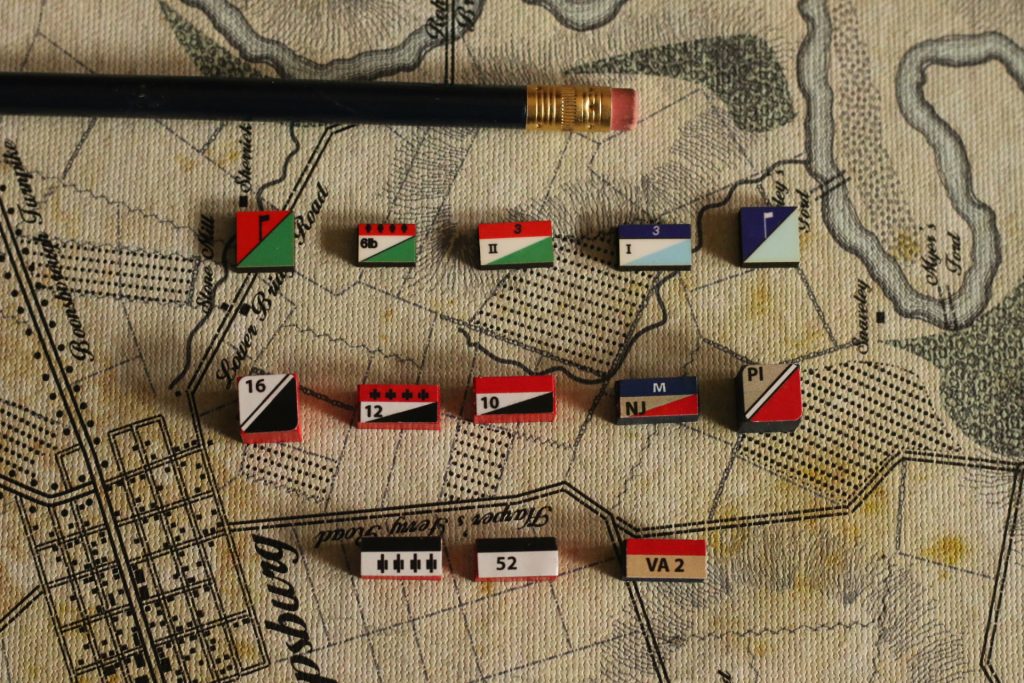
  • The top row is the Too Fat Lardies style,  -laser cut counters.
  • The middle row is our new block pieces styled with the diagonal look.
  • The bottom row is an alternative design for a rectangular look.

Our Question is:  Which is better, Diagonal or Rectangle?

The diagonal lines look detailed and refined.  I like the over all look better.  The down side is that diagonal line on everything can be confusing.  Especially to us modern players used to NATO symbols.  No, these aren’t all cavalry pieces.  The Cavalry pieces are the square shaped ones on the ends.  The rectangle ones are infantry and artillery.

Is the diagonal design more historical and traditional?  No, it’s not.  We’ve been researching this.  Looking at old military maps and antique Kriegsspiel sets, we saw about 50/50.  Some have all rectangles, some have diagonals.  There wasn’t really a standard.

I feel that going with the bottom stickers would be easier for players today to use.  I also like how the font size on this bottom row can be a little bigger.  Much easier for my aged eyes to make out.  🙂  Apart from my weak eyes, I like how we can fit more visible text here for unit names.  I also like the long horizontal line.  Instantly makes me visualize rows of troops.

My only complaint against the bottom row really is aesthetics.   They just look kind of plain and stark to me.  I like the look and appearance of the middle row much better.  The big tall cubes also make the cavalry stand out easily and contrast with the sea of diagonals everywhere.


What are your thoughts?  Which would you rather have?  Do you have any other ideas or suggestions?  Comment below or send us an email.