Tradable Bond Market?

The economy in Supremacy is remarkably realistic. Especially when compared to most other grand strategy games like Risk or Axis & Allies.  I got a very interesting email the other day about a (real life) banker’s reaction to Supremacy.  He was very excited about most of the things he saw.  He did express some concerns about how the Bonds and Loans work. 

This got me thinking….   Is there a way to make the Bonds and Loans tradable on the Market?  Ideally, you shouldn’t be able to take out loans, unless you can first find somebody willing to buy the bonds to back them.  Your payments should go directly to the Bond holding players. 

Another consideration is the rate of interest. With the Loan track, the interest starts out very low.  The deeper in debt you go, the more the interest rises. 

You have to be careful adding rules. Adding tons of complex rules to a game is easy.  How could we incorporate some of these forces into the game in a simple and sleek way that is consistent with the rest of the game design?  Any ideas out there?  Comment below or send me an email. 

Ever wonder what Kriegsspiel Dice looked like?

kriegsspiel

Most wargamers today know that the ‘first’ wargame was Kriegsspiel. It was created by Von Reisswitz as a training tool for the Prussian Army in 1812-ish.  Kriegsspiel is mostly known for its double blind, team play via Umpires.  True but have you ever wondered how they resolved combat?  Did they use CRTs?  No.  They used Kriegsspiel Dice!


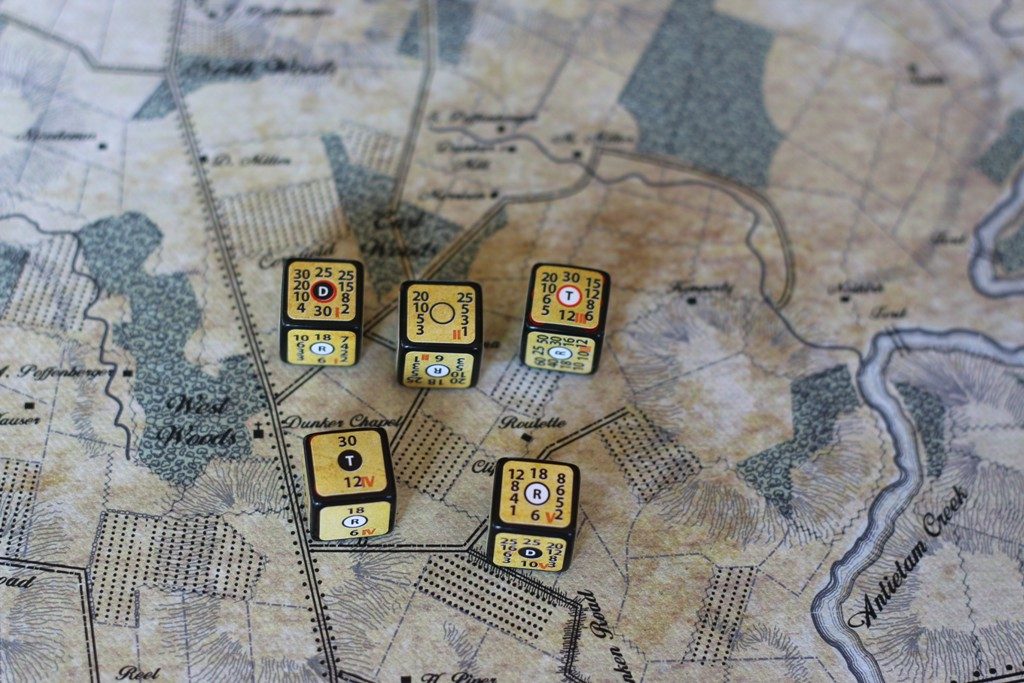
What?! How did that work?  What did they look like?  This is a fascinating piece of wargame history.  They looked like this:
kriegsspiel-dice


Fascinating  but how do you use them?  Essentially, the CRT is on the dice.  Here is a brief run down on the basics:

Each die represents a different combat Odds Ratio, ie. Die I is 1:1, Die II is 3:2, Die III is 2:1 etc. 

The left column of numbers are the casualties an infantry piece inflicts when firing.  They go from close range at the top to long range at the bottom.

The right column of numbers is the same except for skirmishers.

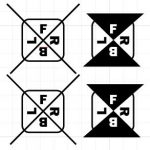
The center column is used for close combat / assaults.  The top number is losses for the attacker, the bottom for the defender.  The letter in the center of the circle denotes result to the unit for assaults:  R-repulsed, D-Defeated, T-Totally Defeated.  Black is a result on the defender.  White on the attacker. 

The big dots in the center are also used for artillery bombardments.  A red circle around the dot means the bombardment starts a fire if hitting buildings.  

Those are the basics.  It is a really detailed and technical combat system and it is based on the REAL combat experience of officers that served on the field in 1812.  You can debate theory, rates of fire and ranges all day long but this is what actually happened in the field with real men in battle.


So how do they play? We did an experiment to find out.  I was very apprehensive.  First I was concerned about all the little numbers.  How are you going to fit all of those on 1 die?  Is the die going to have to be super huge?  Even if you can, will it be too confusing?  How are you even going to be able to read all those tiny numbers and find the one you need?  Sounds like too much trouble.  I’ll just stick with the tables.  I’ve used those all my life.  What’s the big deal?  You just roll and look it up.  I expected that this would be a failed experiment.

Wow, was I wrong. We were completely surprised.  The numbers all easily fit on a standard size die.  With proper formatting and colors, they were easy to see and read.  The exact number you are looking for is easy to spot.  Once you know what the columns are for, it is easy to pick out the exact number for your range.  Your eye just snaps right to it automatically.  Far easier than I would have ever expected. 

The next thing we noticed was how much easier it made playing the game. This is hard to describe.  Here is an analogy:   Have you ever driven a stick shift in heavy, stop-n-go, rush hour traffic?  It wears on you.  Sure shifting is easy.  You can do it but when you keep having to shift up and down constantly for an hour straight, it wears you down.  Especially compared to driving an automatic. 

The Kriegsspiel Dice speed things up.  They free up my aging and feeble brain to focus on other things. It is pretty incredible when you think about it.  There is about 20 tables worth of data all packed onto those tiny, little dice.  No fuss, no muss.  It felt very liberating.


Looking back, I wonder why this old piece of technology was dropped. It is an amazingly powerful and efficient tool.  I wish all my modern games used dice like this. 


Own a Piece of History

From the Game That Started it All


You can get your own set of real Prussian Kriegsspiel Dice here.

You can still get the original Kriegsspiel game, along with a ton of amazingly detailed maps from:

Too Fat Lardies.

You can get scaled metal Kriegsspiel blocks here.

or

Wooden pieces with measuring apparatus here.

Historical Brandywine

One of the things so fun about Brandywine is all the different ways it can be played.  I don’t think I’ve ever seen 2 battles alike yet.  I also haven’t exhausted all the possible strategies yet either! 


Players are free to setup anyway / anywhere they want to.  The game doesn’t even provide for a historical setup.  Still it is kind of nice to know.  How exactly did the battle go down? 


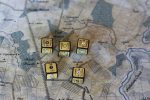
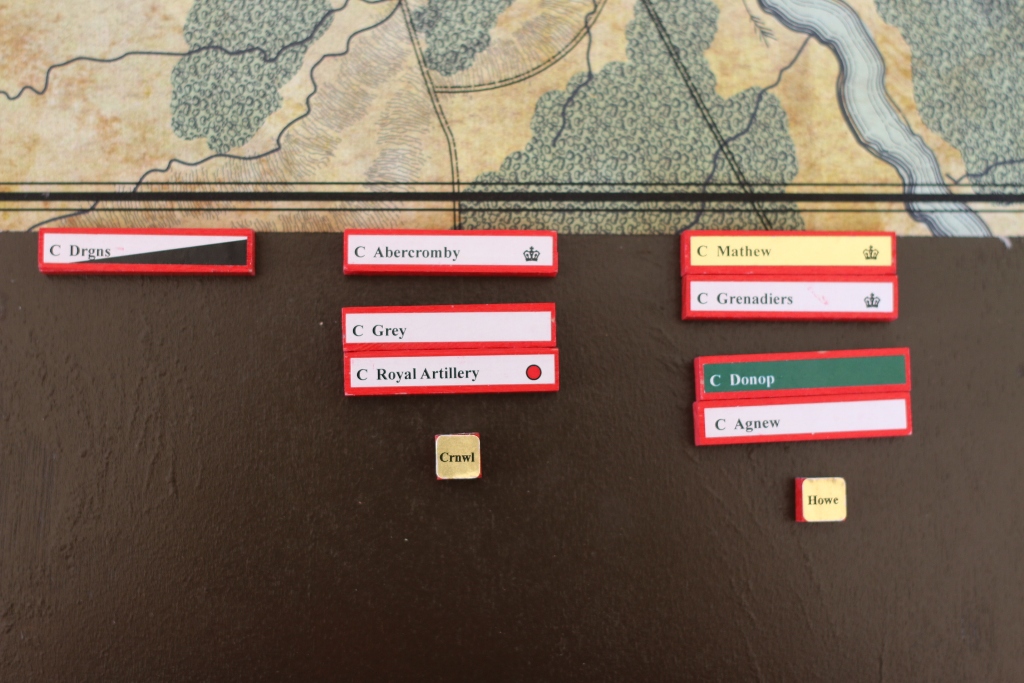
So here you are.  Just for curiosities sake, this is how it opened up historically.  It is a nice reference for players wanting to study the actually historical fight.  


img_8311


img_8313


Written Orders

img_7221I love using written orders in games. It adds so much depth and fun.  Some players however, hate the idea of using them.  It just ‘seems’ like too much fuss. 

This got us thinking… Is there a simple way to simulate the delays and effects of real Kriegspiel written orders?  Instead of written orders, how about some kind of simple order chit system?

img_7224

We experimented with this extensively. We had hidden and rotating Order cubes along with Directional cubes.  We plotted the movement of messengers and implementation times.  It was a very accurate model of what goes on.  It worked very well. 

img_7225

After all that hard work, we dropped it. What?!  Why?  Because it was unnecessary.  In the end, it added almost nothing to the game.  It added complexity and rules.  It added work for the players to do.  What impact did it have on the outcome and flow of the battle?  Almost nothing. 

Was I disappointed? Absolutely not. I was very excited by this outcome.  Pub Battles is even stronger than I realized.  It already incorporates most of effects of written orders in the basic design.  The way the turns work.  The way the commands move.  The way you can attempt to alter the turn sequence.  This IS Kriegspiel.  These rules are simulating the effects of written orders.  

img_7219

All in a simple, elegant 1 page of rules format. There is a lot more going on with this deceptively simple system than you realize.  I think we’ve stumbled upon a gem.  

In the end, the only thing we’ve decided to add for the Sharpsburg battle is a simple rule for adding Chits to the cup. That’s all we need.  I love it when the best thing turns out to be the most simple thing. 

Bounding Overwatch

7thcav11

A common tactic for Cavalry at the time of Custer, was deploying 1 Battalion to lay down fire while a reserve Battalion formed up and got ready behind. When things started getting hairy, the 1st Battallion would bug out by leap frogging behind the reserve. This would give them time to reform and take over next. In this way, a very small Cavalry force could fight in a sustained conflict with a much larger force.  (assuming they don’t run out of ammo)

Most games don’t simulate this dynamic very well. How does the Pub Battles system model this?


The Cav are small in numbers but they can be very subborn. The Sioux are treated as militia. The Cav are regulars. The result of this in the battle is that the Cav stands and holds relatively easy. The most common result is the Cav stands and the Sioux flips and retreats or is killed. About every 3rd shot flips a Cav.

So, after a couple waves of assaults, most of the Cav battallion ends up flipped. Now they ARE at risk. About every 3rd attack will destroy a Cav Company!

Now, if you had a reserve Bn to the rear, no problem. You hold until the front line becomes mostly spent. Then retreat back behind the reserve Bn. They can rally while the reserve holds the line for a few turns. Then they can switch. This models the common ‘leap frogging’ tactics for Cavalry at the time very well.

The problem at Little Bighorn is: There usually aren’t any reserves. Or the reserves are getting pummeled from another direction. This situation is made even worse by your line getting overwhelmed and flanked on each side. This allows for multiple shots on the Cav which is very likely to flip them in the first wave attack.

Then you end up with an agonizing decision to make. Your line is flipped. What do you do next turn? You can retreat OR rally. You can’t do both. Do you stand and rally so you can fight another turn or two? If you do, you will most likely get enveloped. With some luck, you may be able to fight your way out and fall back. The other option is to retreat but then you stay flipped. Your units remain vulnerable to getting killed in the next combat.  

Custer’s Gatling Guns

gatling-gun

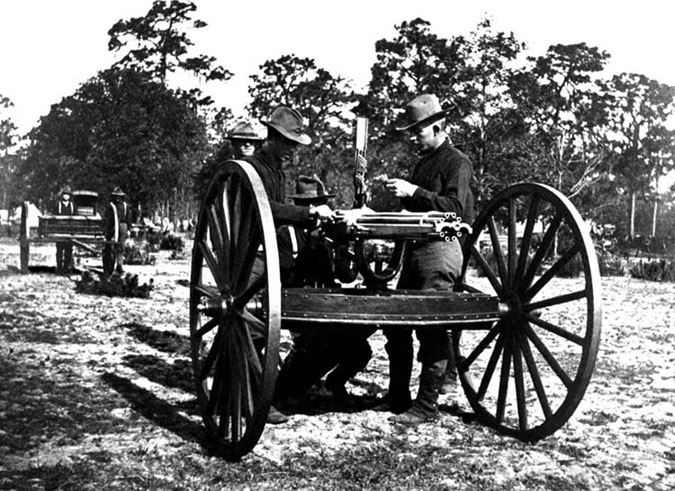
Custer left the Gatling guns behind and for good reason. Bringing them would have greatly slowed the march. In all likelyhood, there wouldn’t have been a battle at Little Bighorn. The Sioux would have escaped.

True but wargaming isn’t just about modeling and duplicating history. One of the most intriguing aspects of our hobby is exploring ‘What ifs?’ It may have not been very feasible but how would Gatling guns have changed the battle? Would it have been enough to save Custer? How and where would they have been best deployed? What impact would they have had? How would the 7th manuvered differently? How would they have changed the their tactics?

Here is a brief report on a recent play test we did with the Gatling guns. It gives you a good idea about how the game works:


I took Custer and Mathey. Mathey set up the G-guns overlooking medicine tail coulee crossing. Custer drove north towards the crossing by Squaw creek.

The Sioux started crossing the Little Bighorn. The G-guns opened up. The first one jammed immediately with no hits. The second one hit 1 Sioux block, sending it retreating and then jammed. :/

The guns would have been immediately overrun and destroyed after that! The only thing that saved them was that Custer rolled to alter the turn. He moved next and turn right around and rode back to cover the guns.

The Sioux attacked. The next turn was a thing of beauty!! The G-guns opened up. They killed about 10 Sioux blocks and sent another 15 running. Custer went back to plan A:   strike across the N. crossing to threaten the NCs.

The next turn, the G-guns popped of a few Sioux then jammed again! Custer tried to come running back to save them but missed the roll this time. The Sioux overran and destroyed them. It was fun while it lasted.

After that, things got rather…… messy.   Custer’s Bn ended up in very awkward positions trying to cover and protect the guns. The whole commanded ended up scattered and isolated somehow.

Sigh.    


Legacy Risk

Has anybody played the new Legacy Risk? This looks like a really neat idea.  It sounds a bit crazy doesn’t it?  Tear up cards.  Throw them away.  Write on the board.  Write on cards.  Change the rules of the game as you play.  What?!  How is that for a grand strategy board game?

Yep, that’s right. If you haven’t heard of Legacy Risk, the game actually changes as a result of how you play.  You can build up cities and destroy them.

We got a copy of this to play. Everybody has been gone running around this summer.  We haven’t had a chance to play yet.  What is it like?  Does it work well?  Can you completely mess the game up by playing it or does it balance itself out and work ok?

How does this compare to Supremacy? Any interesting contrasts?  Any interesting stories of you games?  What happened?  How did it turn out?

Fighting Terror

libya_1842274c

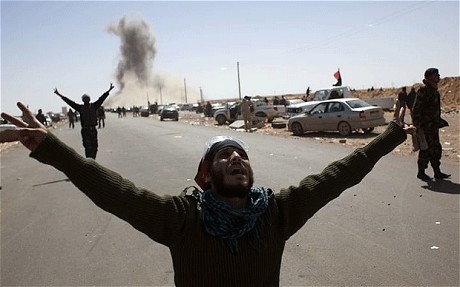
In most strategy games like Risk or Axis & Allies, you plan is clear.  Attack and fight the other Superpowers.  Who is the leader now?  That is what we are used to.  When playing Supremacy, this can get turned upside down.

This can especially become a problem when facing the Terrorist in the new Rising Crescent expansion.  The Terrorists fly under the radar.  Most players ignore them.  They certainly don’t look like a threat.  They start with nothing.  No cards.  No armies.  Not even any money.  No problem right?  Wrong.  That is the biggest danger.  They are often under estimated.  At least at first.

The trouble with terror is that their growth can easily explode exponentially.  The most common mistake is for players to ignore them.  They only have a few armies now.  No big deal.  They aren’t MY problem.  Somebody else will take care of them.  It’s somebody else’s job right?  Wrong!  The Terrorists are everybody’s job all the time.  At least this is how you should think of them.

Sometimes players will complain that the Terrorists are too strong.  You can’t beat them.  It takes a huge effort to clear them out of an area and then they just pop up somewhere else.  It’s frustrating.  Yes, that is true but it is a job that MUST be done.  It is a chore.  Like taking out the trash.  The reason they are growing out of control and taking over the whole game later is because everybody ignored them for the first couple of turns.

You have to beat them down.  Your allies have to beat them down.  Your enemies have to beat them down.  Everybody needs to take a swipe at them.  Think of it as part of your global maintenance routine.

We played a game of Supremacy this week.  The Terrorists were ignored.  They built up and swarmed all over Europe.  The EU  player started complaining that they were too hard to beat.  It wasn’t realistic.  They kept popping up faster than they could take them out.  They completely overran Europe and conquered them.  Is there a play balance problem here?  Is this realistic?

Take a look at the real world Europe today.   Look at the demographic trends.  Project that out another 4-8 years.  What does that end up looking like?  Does it look realistic now?

I wonder if the real world Superpowers will wake up in time to beat down terror into a manageable size before it’s too late?

Which Flag?

Washington's%20Continental%20Flag%20Standard


We included optional bonus flags for Washington and Howe with Brandywine. What are these for?  What’s the difference?


We did these just for fun. Which is better?  Well, it kind of depends what you want.


The Standard Flags are all the same. The main advantage here is hidden intel.  Which HQ is it?  If they are all the same, you can’t be certain.


Washington’s personal standard is just plain cool. It adds a nice historical touch.  Howe didn’t have one but it seems strange if he doesn’t have something unique if Washington does.  These optional flags look great.  The downside of course is that the opponent knows exactly they are now.


How big a deal is this? Well, if you are playing a standard game, with two players it’s not a big impact.  After the first turn, everybody usually knows who’s who anyways.  Brandywine is a small battle.  There aren’t many commands.  It is easy to watch and keep track of.


With an Umpire, this can become more of a mystery. Except with an Umpire, it also doesn’t matter.  You can’t see the real map.  You only know what the reports tell you.  So the optional flags are still hidden.


How could the optional flags hurt you then?

IF you are playing the optional:

  • early start open
  • hidden command chits
  • turning spent units face down
  • reassigning blocks to other commands before the battle


For a 2 player game, these rules can add a lot of hidden unknowns to the game. Now you can’t be exactly sure what the enemy has, when and where they are, who can still move next and who can still attack?  Unless of course you are using the optional Howe and Washington flags….   That blows a lot of your intell.


Will you be playing these rules often? If not, it probably won’t matter.

Frustration as a Weapon

FrustrationAltanakaCan real command issues be a fun game? Are they compatible?

 

Conventional wargame wisdom is no. Real command is boring, dull and frustrating.   A game has to be fun. To be fun, it must be instant. No delay. No frustration. No unknowns. Must be complete knowledge and complete power and control.


Some of these ideas are changing. Columbia broke a lot of ground in this area.


This is what surprised me about Kriegspiel. It’s more like real command. It is boring, dull and frustrating? My experience was quite the opposite. It was very exciting and interesting. It can be frustrating. Frustration can = tension and fun in a game.


I think maybe there is more frustration at first. I can’t just move my pieces. I have to write orders first and then wait until they receive it. There is the delay. You have to start thinking ahead and planning for this. It’s not bad but it does run contrary to our instant gratification culture today. I can’t wait that long! I want an answer now! I want to move the piece myself and know what happened immediately. I can’t wait a whole turn to find out!


With a little practice, you adjust to it. Then it’s not frustrating. After a little more practice, then you start thinking…..


Hmmmmmm…….   They do this. I have to see it. Write orders. Delay. Then reaction. There is a lag. I move. Delay. They react. They move. Delay. I react. Let’s look a step further. Could we use this as a weapon? You betcha! People like Alexander, Hannibal, Napoleon, Jackson, Patton and Guderian were experts at it. Let’s think a couple moves ahead here. Much like Chess.


If we move like this, what will the enemy do?  They will likely react like that. Except there will be a 2 turn delay. Guess what? Now you know the future. You know where the enemy will be in 2 turns. You also know where he will not be, even before he does. Is that useful information? Can I get a ‘Heck Yeah!’?


If you know this ahead of time, you don’t have to wait until the enemy reacts, then delay while you send your next batch of orders. Send the orders now!! Then there will be NO delay. At least not for you. Assuming all goes well and you plan and time this right, the sequence will now be:


  1. You order.
  2. Delay.
  3. You move.
  4. Enemy orders to react.
  5. Delay.
  6. Enemy moves to react.
  7. You move.
  8. Enemy orders to react.
  9. You move.
  10. Enemy orders to react.
  11. You move.
  12. Game over.

This is called seizing the initiative. Keeping the momentum. Patton described this as rocking the enemy back on his heels by a good hard shove. Once he is off balance, it only takes repeated light shoves to keep him there, while you steadily advance.


The enemy is always off balance. Always in an awkward position. They never catch their breath. You are always 1 step ahead.

Frustration


Does that sound frustrating, dull and boring? Dishing it out or being on the receiving end of this, it sounds like a pretty exciting and fun game to me.