Telestrations -Review

What does Telestrations have to do with wargames and military leadership?  Everything.  Telestrations IS Kriegsspiel. 

We often laugh after playing Kriegsspiel.  What did you think was happening?  What was really happening?  What did you tell them to do?  What did they actually do?  Why?  These differences are often hysterical!!!  Well, I guess we laugh so we don’t cry. 

Real leadership and real command is about communication.  Writing orders.  Getting your team to work together.  How often does this break down?  I have 2 words:  Murphy’s Law.

Remember the Chinese Telephone game we played as kids?  Everybody gets in a line.  Then you whisper a sentence in the first person’s ear.  They quietly pass it down the line.  When you get to the end, the result is completely different right? 

Telestrations is Kriegsspiel without the maps and musket warfare.  It is Pictionary and Chinese Telephone rolled together into a fun, easy party game. 

How does it work?  You pull a card with a word on it.  You have to draw a picture of that word.  You pass your picture to the next person.  They have to guess what the word was.  Here is an example starting with the word:  Recliner


Hysterical!  If you don’t have it, get it!!!  This is one of the best games ever made.  Everyone can play it.  I recommend the big 12 player party version.  Everyone will want to play.  This is a classic.  

Caution:  Do not play this if you have broken or cracked ribs.  You are going to be laughing a lot during this game!

Gettysburg Replayability

I have just completed another game of Gettysburg,  and this was a Union Major Victory (Confederate concede on turn 7 of Day 2 with ten blocks lost).

First off, for simplicity purposes, I count all blocks no matter the type. In this particular game all losses were infantry and both elites were lost.

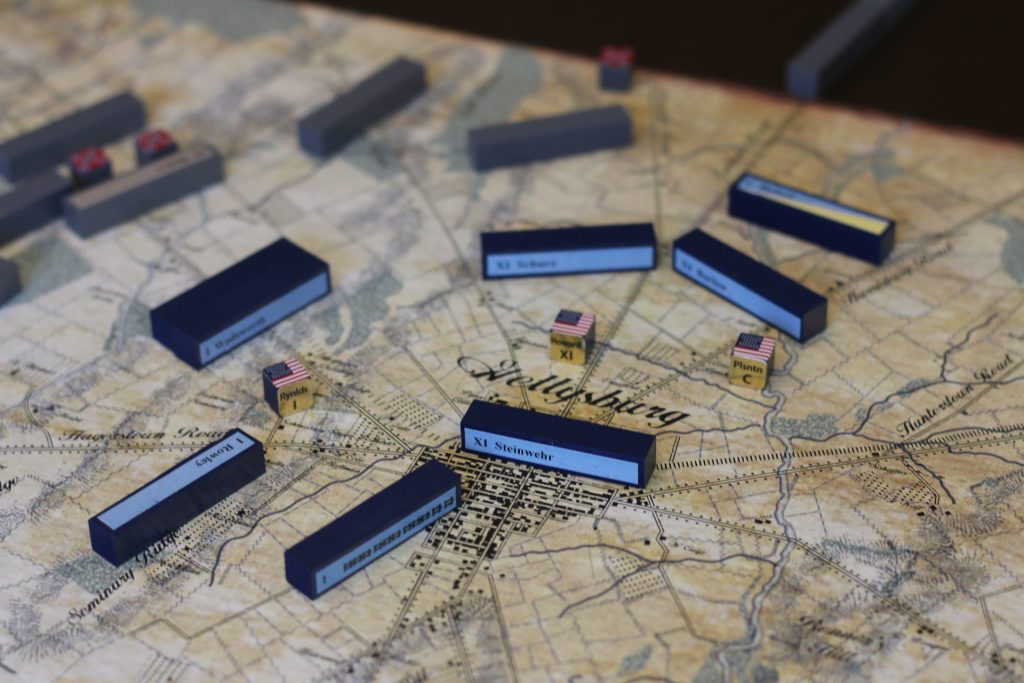
I find that Gettysburg has a certain flow. On day 1, Lee has a shot at a major Victory. This is a little misleading as he actually has the smaller force for the first half of the day, and not much more than the Union by the end of the day.

Lee may have a chance on the first few turns of Day 2, but somewhere the tide turns. When that has happened is the critical point of the game, and the one that tests the player’s judgement.

If the South switches to the defensive a turn late, they can lose quite quickly. If they switch too soon, they might miss a chance at a major.

Switching from a desperate bid for victory, to a cool withdrawal, is such a major shift in thinking that it more frequently results in pushing too long.

Frequently,  the game then becomes very tense for the Union player, as now they hold the cards. They must push Lee over the edge without ending there themselves.

This is made tricky by approaching night. Come morning, Lee will have had a chance to recover, and Stuart will arrive!

In the best games, Lee manages to wrest initiative away from Meade, as the game see-saws back and forth.

This is why this game has so much replayability.


Mike Strand

Kriegsspiel Example

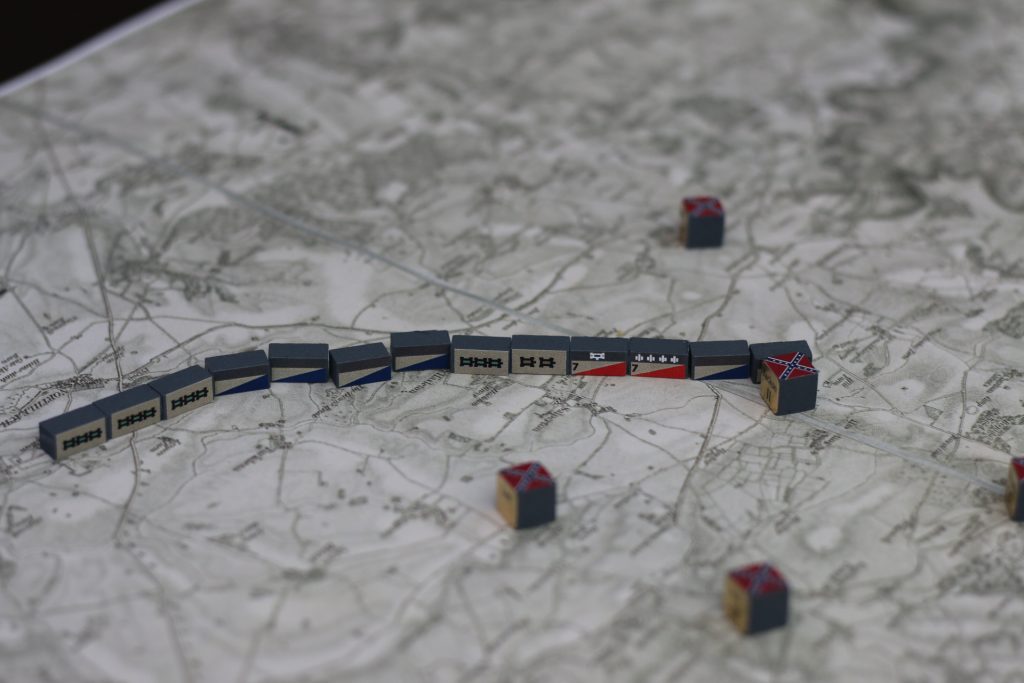
Here is a fun little example of a Kriegsspiel problem / situation.  What would you do if you were in command here?


Civil War era.  Operational scale.  Each block represents a Division of about 5,000 men.  You are in the Confederate Army of Northern Virginia.   

The Army of Northern Virginia has been marching NW for several days.  The Army of the Potomac is reportedly to the NW and is moving in your direction.  You are closing with the enemy and a battle is soon expected.  Comparative strength is unknown. 

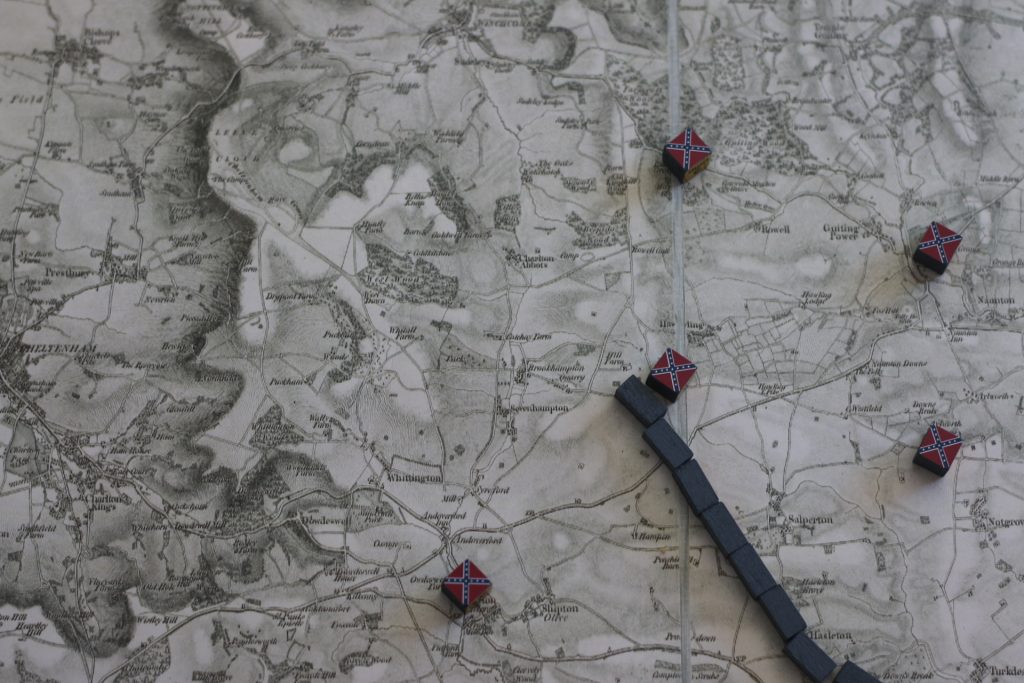
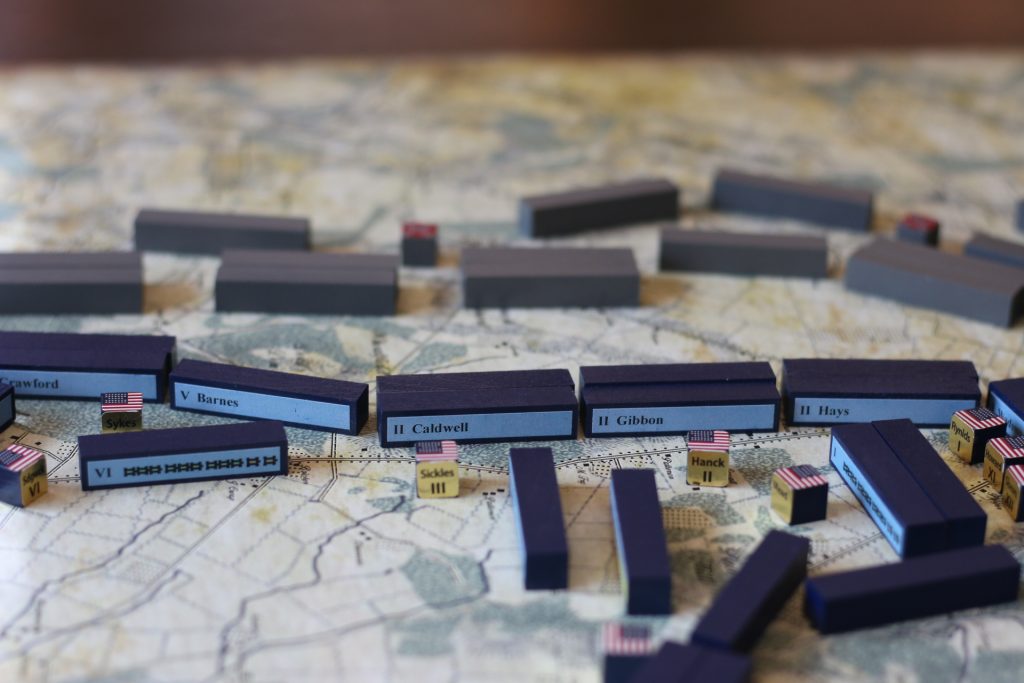
The Army of Northern Virginia is divided into roughly 3 equal Corps.  You are in command of Jackson’s II Corps.  You are in the center.  Longstreet is to your left.  Hill is to your right.  Those little flag / HQ cubes mark your best guess as to where your friendly columns are currently.  You have marched for 3 days at a leisurely but steady pace:  5 miles per day, then stopping to forage the area for supplies and setting up camp for the night. 


You have marched 5 miles today since dawn.  It is now mid morning.  You have just halted the column and are preparing to send out foragers when you hear a fight break out to the SW of your position:  musket and canon fire.  This is likely in the vicinity of Longstreet’s Corps which is about a 2-3 miles away.   This is the first contact with the enemy. 

Map ahead. Enemy is expected to be approaching from the NW or upper left. Your LOC runs back to the SE.

Lee’s HQ is about 2-3 miles east of you. What do you do?  What are your orders?

What are the options?  What is the best move here?  Why?  Keep in mind that the clock is ticking.  Every minute you spend thinking and writing, delays your troops response.

Comment below. 

Do you need more information?  Have questions?  Ask!  I’ll provide Umpire answers.  🙂


First Impressions: Pub Battles Gettysburg

So how is this new Gettysburg game?  Is it any good?  What is it like?  Here are some initial reactions from Mark:


I have been discussing ideas with Mike, but I have only played with the rules as written – and then the last couple times with the Baggage Train idea of 1 unit per Train rallying.  That rule, by the way, really improves the game for my tastes!


Overall, I enjoy the game very much.  I think it handles Day 1 as well or better than any other Gettysburg game I have played.  It unfolds in a historically plausible manner, is fast paced, and leads to plenty of solid, difficult decisions for both sides.  The PB system is responsible for a lot of that.  The random chit draw along with the ability to try and alter the draw is what makes the 1st day challenging and variable.  


That being said, the game suffers some of the same problems all Gettysburg games suffer in days 2 and 3.  There are a lot of units, both sides are very strong, and it is essentially a stalemate.  I find that in the opening turns of Day 2, there is still a feel of a good game going, with the South having an opportunity and the North just weak enough to make it exciting.  But unless heavy losses are inflicted quickly, the game tends to bog down into a game where the South is pressured to win (since I interpret the rules to mean that if you play past day 1, the only kind of victory available for the South is a Major victory by Defeating the Union through 50% losses).  The South no longer has any kind of positional or strength advantage by the second half of Day 2, so after that, it is a matter of attacking and hoping to out-roll the Union.   Now, that is still an enjoyable process, especially since the game moves fairly quickly even once all of the forces are on the board.  And the arrival of the cavalry on Day 3 adds a touch that most games do not have.


Toning down and getting rid of unit Recovery could help with this.  Day 1 saw heavy Union losses, twice as many as the South took.  After day 2, both armies were greatly reduced in strength.  But in my games, both armies tend to enter day 3 almost full strength.  That not only means a stalemate, but it makes the idea of the South eliminating 50% of the Union’s infantry almost impossible.


The FoE rules are more difficult to use in this game.  That is due to the density of pieces and the busy terrain on the map – there are many slopes and slices of woods all over the place.  So every unit on the front has to measure its LOS to see if and where it extends a FoE.  And measuring can be difficult when the terrain is well-covered with units.  I am not sure if there is a solution – but any kind of streamlining to make the process easier would help.


But overall I like this game, and I certainly would prefer it to any of the more complex games out there.  Relatively few units, simple rules, variable command system, and a game that can be completed while covering all 3 days (most Gettysburg games simply cannot be completed in a reasonable amount of time, if at all!).  I would say this adds a new take on a well-covered subject.


Mark


Do Board Games Suck?

Anita Louie brings up many good points in this article.

I agree with her in many ways.  During design, we always start with a key question:  What is the ‘game’?  How do you win?  What is the point? 

All too often in board games, I feel like the point of the game is a bunch of boring work.  Collect and track a bunch of resources.  They make me feel like a worker drone on an assembly line.  Why are we doing this?  To me, that is not fun.  It’s doing a bunch of busy work.   


What is the point of most video games?  To practice and memorize the proper sequence of buttons to be pushed quickly?  Find the right weapons on the level in the right sequence so that you can beat the level?  Do it a 100 times until you can get fast enough at it to succeed?  Is  your goal is to develop rapid hand eye coordination and memorize a bunch of moves?  There is a time and place for this but then what?  Not my idea of fun.


To me, games like Monopoly, Life, Clue, Battleship, etc. are really for kids.  The point is to teach basic skills like counting, taking turns, following rules, making change for money, etc.  They are really just slightly more advanced versions of Candy Land and Chutes & Ladders.  There is an educational purpose to this but for adults?  Not fun.   


Where do most  wargames fit in here?  I hate to say it but I have to agree with her.  Most wargames fall into the same category.  What is the game?  They amount to attritional exercises of accounting, record keeping and tracking resources.  Busy work.  How much fun interaction is there with another live human?  A contest of intelligence and wits? 


One goal she doesn’t mention is education.  Why do we play games?  I feel that a big goal in wargaming is learning.  Maybe the game isn’t fun.  Maybe it’s not an engaging battle of intelligence with a live opponent.  Still, I like playing them because I want to learn about this war, campaign or battle.  I want to understand better how and why it was fought.  How and why it was won or lost.  I see many wargames more as interactive models of historical conflicts than an actual ‘game’. 


Does Anita have a driving need to learn and understand military conflict and history?  No.  For her it is all about fun and meaningful interaction with friends;  with live people.  If I wasn’t a military history nut, I’d feel exactly the same way.


I wonder what Anita would think of Kriegsspiel?  I have to imagine that she would love it!  To me, Kriegsspiel is exactly what she is talking about.  What is the ‘game’?  It is people.  How do we interact with them?  Working together.  Teamwork.  Communication. 


These are the things I love about Kriegsspiel.  Anita would love them too, IF you could ever convince her to try it. 


Gettysburg Launch!

Ok, we are ready to launch!  Our Kickstarter should be ready to go in about an hour.  You’ve been pre warned.  🙂

This will be a very short and quick Kickstarter.  -like Waterloo.  If you want to get in, move quickly.  It won’t last long.  

If you miss it, no worries.  We’ll get a page up soon for Pre Orders.  

If all goes well, we should be ready to start shipping in a few weeks in the order we receive them.  


Team Building Cooperative Board Game

Forest of the Impaled is one of the best team building cooperative board games I’ve ever seen.  Six Muslim players must cooperate as a team to defeat the historical Vlad Dracula.  The trick is:  They Can’t Talk!  Actually, the rules say they can’t “communicate” in any way, to include pointing, eye rolling, groaning, banging your head against the wall, etc. 


“This game is about teamwork, leadership and communication.” 


This game plays fast (1-2 hours) and is easy to learn and teach.  It has some fun stuff in it:  Castles, secret mountain passes, hideouts and impalements but really this game is about teamwork, leadership and communication.

One player is Dracula.  Up to 6 other players must cooperate as a team of Muslim invaders to conquer Romania.  This asymmetrical situation immediately raises a very interesting question.  What is better?  The efficiency of a small 1 person, autocratic, dictatorship?  Or a very large, slow moving team?  Are more minds better than one?  What are their advantages and disadvantages?  With practice, a good team can overcome their weakness and maximize their power of synergy.  How do you do this?  Through leadership, planning and communication.

The Muslim players can talk and plan freely before the game starts.  After it begins, players can only talk briefly with other players while they are in the same spot on the board.  So what happens when the plan gets disrupted? 

Let’s say 3 players are supposed to move up the middle and take on Dracula.  I’m supposed to take my army around the west to capture castles and drive deep into Transylvania.  I shouldn’t be facing any serious resistance.  That’s the plan.

On turn 1, Dracula unexpectedly races across the board to the west and bam, there he is right in front of me.  Now what?  We can’t talk.  What should I do?  What should the 3 players in the middle of the board do?  We need to adapt but how? 

I could march over to talk to them but that will waste a couple of turns to get there and then back.  There usually isn’t time for that.  The Muslims only have 4 turns to defeat Dracula!

Painful.  Agonizing.  Interesting.  Fun.  Also the same types of situations we run into at work.  Well, maybe not impalements and castle sieges but things like:

  • How to plan for the unexpected.
  • How to react to the unexpected when you are stopped in the field  and not able to consult your team or management.  -or maybe how do you react on the spot BEFORE you can consult your team and management.  
  • How important it is for everybody at your organization to know the strategic goal and keep it in mind.  
  • How will your individual decisions and actions affect that plan and others on your team. 

Just to name a few.  

This game brings out the very best in team building, cooperative board games. 

Learn More  

Antietam Reserves

We introduced our rules for HQ Reserve cards in Antietam.  It was a great rule that took things in a great direction.  This is my favorite rule of the whole system!


What you see on the board.

It was a great improvement and start.  Since then we have been able to use them in other battles.  This experience has given us a better understanding of exactly what they do and how the work the best.

Note other HQs and even whole Corps can be held in Reserve.

Given all this, we are altering our lineup for HQ Res cards in Antietam.  This update is easy to implement.  All you need to do is take out some of your cards and trash em!


The New games are going to come with only 3 cards per side as follows:

  • Lee, Longstreet, Jackson
  • McClellan, Hooker, Burnside


This is one of those strange cases where less is more.  Most of the Federal Corps are small.  Many only have a couple of divisions.  If every Corps has a Res card, they become diluted and ironically have less of an impact.  We have found that 3 per side here work much better. 


What the Feds see.

Note that you CAN put other Corps in Reserve!  So this makes it much harder for the ANV to read exactly where the Potomac is and what their true intention is.  Where are there reserve Corps?  How many left?  You don’t know until they march out. 


What the Rebs have.

Give it a try!  We think you’ll like the effect much better.   

Managing Combat at Gettysburg

In most wargames, you can’t manage the combat result.   After you move and commit to an attack, your decisions are over.  There is nothing left to do but roll the dice and pray for a good result.  In Pub Battles, you can actually manage the fight, blow by blow as it unfolds.  There are many decisions left to make.  How exactly do you want to fight this engagement?

Often new players to Pub Battles will just stay every round of combat until contact is broken.  Playing this way leaves everything up to fate.  By carefully managing your combats, you can shift the strategic edge in your favor to win!  Let’s look as some examples:

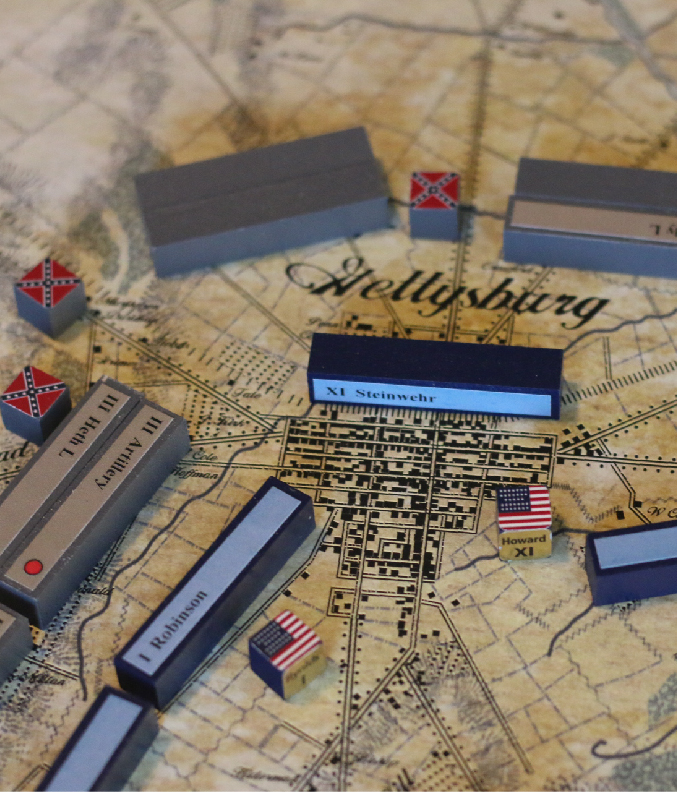
This is the opening of Gettysburg.  (just making this up, not the actual OB)  It is early in the day.  We are defending McPherson’s Ridge.


The Confederates have advanced to attack Robinson’s Division.  All movement is finished and we are resolving combat at the end of the turn.


If you’re not familiar with Pub Battles, dice normally score hits on 4-6.  (only 5-6 if the defender is under cover)  On the first hit, your unit flips to its Spent side:  label up.  The second hit will force your unit to retreat.  A third hit will destroy it. 


Round 1:   The Confederates score 1 hit flipping Robinson.  Heth’s lead wing takes 2 hits.  He flips and retreats but his supporting wing advances to press the attack.

Now it’s decision time.  At the end of the round, we have the option to voluntarily retreat and break off this engagement.  Do you retreat and fall back, or stand and fight another round?

We have the advantage of the Hill.  That gives Robinson cover.  The Confederates only hit us on 5 or 6.  We hit them on 4-6.  Both sides roll 3 dice.  On average they will cause 2/3 of a hit.  We will cause 1 1/2 hits to them.  We should stay right?

Well, even though the odds are in our favor, with a little luck the Confederates could still easily score 2 hits on us.  Two more hits would destroy Robinson.  Is that a big deal?  It’s just 1 block.

Not normally but consider the strategic situation here.  This is the opening of Gettysburg.  There are very few units on the board, especially Federal ones.  Every single piece has an exaggerated importance now.  If we lose Robinson on the opening attack, first thing in the morning, we’ll be critically short that block for the rest of the day.  The impact of losing him is magnified.

If Robinson get’s destroyed defending Cemetery Hill on Day 2, no big deal.  Most of the Army of the Potomac will be here tomorrow.  We’ll have plenty of blocks to spare then.  Right now we only have a few blocks to delay and contain the waves of rebels pouring onto the field.

Given this, I’m feeling more cautious.  I’d rather not risk it.  We have ground and time to give up.  We don’t have many men to lose right now.  We can play cautious.  We decide to voluntarily retreat:

Heth takes McPherson’s Ridge.  Fine.  Next turn we can Rally Robinson back to upright Fresh status, fall back, reform our lines and continue the good fight.


What could have happened if we stayed?  Heth most certainly would have stayed and pressed the attack.  There is no good reason for him to back down here.  There are many possible outcomes.  Here are a few likely ones:

1         -We score 2 hits, Confederates score none.  We hold the ridge and successfully delay the Rebs for a couple of turns while they Rally and prepare to attack again.


2          -We score 1 hit, Confederates score 1 hit.  We are shoved back anyways but we flipped another Reb unit costing them more time.


3         –We score 1 hit, Confederates score 2 hits.  Robinson is destroyed!  The ridge is lost and we are going to be hard pressed to slow the Confederate advance on Cemetery Hill.  Looks ugly doesn’t it?


Three easily possible outcomes.  Notice that WE have the power to take the 3rd, worst option completely off the table.  We just need to exercise a little discretion and voluntarily retreat.


Let’s turn the table around and look at this from the Confederate perspective.  Let’s say the Feds recklessly decided to stand with Robinson and they got lucky.  He survived, held the Ridge and scored 2 hits on Heth, forcing him back:

We move on to the next turn now.  We are the Confederate player.  Federals have already moved and are incapable of bringing up any support for Robinson.  Robinson did Rally, but our artillery bombardment flipped him back to Spent status:

We have no other Fresh units in position to attack this turn.  We have 2 basic choices:

  1. Delay our advance this turn and Rally Heth to Fresh so that we can attack next turn at full strength:

  1. Strike now! Advance to attack Robinson again while Spent:

Option 2 is risky.  Is it worth the risk?

Odds are very good that we would see a unit destroyed.   Odds are also very good that we would take the Ridge and destroy Robinson as well!

As the Confederates, we do have units to lose now.  Time is much more important.  This is a close call.  I could argue either way on this.  Personally, I’d go for the risky option 2:  Attack now while Spent.

Notice all the decisions here.  Many things in our control.  Many ways to fight this out.


Why Napoleon Lost Waterloo

Many blame Grouchy for Napoleon’s defeat at Waterloo. Why did Napoleon lose at Waterloo? Because of these orders.


Lessons from Kriegsspiel

A very big question.  Over the course of designing Pub Battles:  Waterloo, several other musket era games and playing Kriegsspiel, I am gaining a deeper insight and understanding of this subject.  Let’s look at some examples:


Kriegsspiel Antietam

Emily orders Gabe to advance SE down road X to attack the enemy.  The problem was road X doesn’t go SE it goes SW.  What should Gabe do?  Should he travel SW down road X and attack nobody  OR should he travel SE down road Y and attack the enemy?  What did Emily mean?


Marengo

Napoleon orders Desaix to march south to recon enemy positions and block off any routes of escape.  The troops form up.  They are ready to begin marching south when they suddenly hear cannon fire to the north:  where Napoleon had the Austrians under siege in Alexandrie.  What should Desaix do?  Should he obey orders and start his march to the south?  Should he directly disobey these orders and march north to the sound of the guns in case Napoleon needs his support? 


June 17th, Waterloo

After the battle at Ligny, Napoleon takes the main army up the Brussels road to pursue Wellington and bring him to battle.  He detaches Grouchy with 2 Corps.  Grouchy’s orders are to march east to Gembloux and pursue the Prussians.  The problem is that the Prussians march north.  What should Grouchy do?  Should he march north in pursuit of the Prussians or march east to Gembloux?


June 18th, Waterloo

The Prussians seem to be concentrating at Wavre.  Napoleon orders Grouchy to attack the Prussians at Wavre so that they cannot join Wellington at Waterloo while he attacks them.  As Grouchy begins to march to Wavre, he hears heavy cannon fire starting at Waterloo.  What should he do?  March to Wavre and attack the Prussians as ordered or disobey his direct orders and march to the sound of the guns to support Napoleon? 

Are you noticing a trend here? 


Why did Napoleon lose at Waterloo?  As wargamers we tend to compare combat & movement factors, leader ratings and hex terrain.  As miniature players we tend to focus more on comparing individual unit weapon performance and morale ratings.  We can argue and quibble over details like this till the cows come home.  From my experience in Kriegsspiel, I’d say all of this is trumped by orders and communication.  Why did Napoleon lose at Waterloo?  Because of his orders to Grouchy.  What will your people do when given orders with conflicting goals?  God only knows. 

What did Gabe do at Antietam?  He surmised that Emily got her directions messed up.  He disobeyed orders.  He immediately attacked by marching down the wrong road to attack the enemy in the wrong direction.  He sent Emily a snarky message back telling her what he was doing and that she needs to learn how to read a compass!

I discussed this game with Gabe last week.  (Amazing because we played this game several years ago but we still talk about it and remember it vividly.)  His response to this problem in the game was pretty bold.  I asked him to consider the ramifications in real life, a real war, thousands of men’s lives at stake.  I pointed out that his military career and retirement were at stake.  His chances for promotion later.  Possibly a courts-martial and firing squad if he disobeyed orders.  He went down the wrong road in the wrong direction.  This is disobeying direct written orders during a battle with the enemy.  Would he still have responded this way in a real war?

After consideration, Gabe agreed that his response would have been very different in a real war.  Instead, he would have sat and did nothing while he wrote back and respectfully requested confirmation of the confusing orders.  His response:  delay and inaction.  Sounds about right.

What did Grouchy do on the 17th of June?  Put yourself in Grouchy’s shoes.  Napoleon, the greatest military mind of the age, orders you to march to Gembloux.  If the Emperor of France orders you to march to Gembloux, you march to Gembloux.  How could you do anything else?  As it turns out, this march delayed Grouchy’s column which ultimately led to Napoleon’s defeat at Waterloo.  It put Grouchy a half day’s march behind the Prussians.  Imagine yourself in Grouchy’s command.  You read the order from Napoleon, wad it up into a ball and throw it away saying:  “Nah, I think I’ll go north instead.  He doesn’t know what he’s talking about.  I don’t think the Prussians are going to go that way.”  Yeah, that’s not going to happen. 

The same situation on the 18th of June.  When the guns opened up at Waterloo, Soult and Gérard urged Grouchy to march to the Emperor’s aid.  Grouchy refused.  Why?  His orders were to march to Wavre!  We have the benefit of hindsight now.  Put yourself in Grouchy’s shoes then.  March to Waterloo?  Why?  So the Emperor can have you shot for disobeying direct orders?  Grouchy’s attack at Wavre was supposed to tie down the Prussians and keep them from marching to Waterloo.  That was the Emperor’s plan.  What if disobeying orders and marching to Waterloo is what causes Napoleon to lose?  Now Napoleon lost the battle because you disobeyed direct orders!  That won’t be pretty.  At least by marching to Wavre, Grouchy had the defense of saying:  “But that’s what he told me to do!”

Ok, now let’s go back to Marengo.  What did Desaix do?  He disobeyed orders, turned and marched immediately to the sound of the guns.  Why the difference here?  First of all, Napoleon was still early in his career.  He hadn’t quite reached the status of “Military Genius of Our Age” yet.  It was easier to take a gamble and risk with a young, upstart revolutionary general. 

There was also a big difference in priorities.  Desaix was just on a scouting / recon mission.  Not a huge deal.  He could always return the next day to scout and recon.  An unexpected, critical battle breaking out that could decide the entire campaign is a much bigger priority.  Better to get there just in case…  There isn’t much to lose. 

Grouchy faced a much more difficult dilemma.  “Pursue the Prussians” is a much higher priority than scout, recon and forage.  On the 18th, Grouchy’s orders were to “Attack the Prussians” to prevent them from joining Wellington.  This is a mission critical priority.

“March to Gembloux and pursue the Prussians.”  The Prussians march north.  Gembloux is east. 

“March to Wavre and attack the Prussians.”  Wavre is north.  The Prussians march west. 

Why did Napoleon lose at Waterloo?  Because of these orders.  Many blame Grouchy for Napoleon’s defeat at Waterloo.  Ultimately, a leader is responsible for his command and the performance of his subordinates.  These are elementary mistakes that you see immediately in Kriegsspiel.

Notice how these orders put the subordinates into a bind.  Do Y and X.  What if that becomes impossible?  Why put all this stress on your people?  You are setting yourself up for failure.  How can you avoid conundrums like this in the first place?

George Patton used to say:  Tell people ‘what’ to do, not ‘how’ to do it.  How would Patton have written these orders?

Instead of:

“March to Gembloux and pursue the Prussians.”

Patton would write:

“Pursue the Prussians.”

Instead of:

“March to Wavre and attack the Prussians.”

Patton would write:

“Pursue the Prussians and Prevent them from joining Wellington.”

-except there would probably be a lot more swear words thrown in there. 

Good orders focus on:  What to Do.  They focus on the end result or goal of the mission.  Where is Grouchy?  I don’t know where the *^%$#&@ he is but wherever he is, we can be sure that he is all over the Prussians like %&$#*@#$%^!

Napoleon does deserve a little slack.  He was suffering from very heavy health issues during the campaign.  He was not at his best.  He certainly wouldn’t have gotten as far as he did if he wasn’t doing something right. 

We can learn a lot from Napoleon, Waterloo and Patton.  We can learn important things from wargaming but the most important lessons to be learned come from Kriegsspiel.