Antietam Contest Answer

First of all, I’d like to point that this contest is a great example of a Multi-Player game.  It is a total mess!  Pub Battles can be a great and rewarding solitaire game.  It is even better if you can get more players together to play in teams. 

At first, you might think that there isn’t enough to do for a player.  If all you do is run 1 Command, that means you only control 2-6 blocks.  How can that be a game?  Because of this!

Yes, it is very different from the types of wargames we are used to playing.  We are used to controlling hundreds of pieces by ourselves.  We can do everything and have perfect control.  The game isn’t moving your pieces.  It is communication, teamwork and accomplishing the objective anyways.  

I suggest that real command is a lot more like this contest.  It is also a lot more fun.  It is also easier for more people to do and join in.  You don’t control everything.  You aren’t responsible for everything.  You only control 4 blocks.  You are on a team trying to defeat the enemy but you can’t talk. 

Yes, you don’t have tons of pieces to control.  There may not be anything going on in your sector of the battle for awhile.  I submit that the issues like this that you have to wrestle with can be just as engaging and even more fun.  –Especially when you can watch the whole board.  You can see what needs to be done.  You can see what everybody is screwing up but you can’t talk about it.  You can only control your 4 blocks to the NE.

I can’t over emphasize how GREAT this is.  Looking back over my entire life of gaming, I have 4 great moments that stand out.  Moments that we remember vividly and still talk about with excitement years later.  Three of them resulted from a Multi-Player, Pub Battles conundrum like this with limited communications.  (the fourth involved a player announcing a 12 ICBM launch in Supremacy)

I know it is hard to round up players.  I urge you to make the attempt.  It is worth the effort.  Pub Battles is a simple game.  How hard can it be if you only have to control 4 blocks?  If you are a newbie, you can’t do too much damage with that, right? 


Ok, so enough preaching.  What is the correct answer?

Although I am partial to answer number 2:

“2.  Write a letter to President Lincoln, asking him to remove McClellan from command for incompetence and give the Army of the Potomac to you.”

Answer number 1 is the best answer

“1. March SW and attack the 2 Confederates to the West near the river. (far left)”

I would also do part of 7: 

“7. request clarification”, and inform McClellan of my interpretation of his orders and current action. 

Followed up by number 11:

“11. Sigh and open a new bottle of whiskey.”


To refresh your memory, you can see the original contest here.

Do you agree with this answer?  Why?  Why not?  Join the discussion below in the comments.  


Waterloo Color Test

Ok, I couldn’t stand it anymore!!  Seeing all those blue and grey blocks for Antietam sitting there next to the red British blocks for Brandywine, I couldn’t stop thinking of Waterloo.

So last night after work, I created a 1st draft set of Waterloo blocks.  (Yes, that’s what I do for fun!)  The French are already set.  We’ll do the same colors and style from Marengo.  I think the Prussians look good.

I’m not sure about the British.  What should the colors be?  How do these look?  Any ideas or input?  Leave us a comment.  


This British army looks like a hodge podge mess.  Lots of Militia grade units.  It seems like they are coupled with Elite British units.  This automatically makes me start thinking of how you would use this army in Pub Battles.  

With hidden intel, it’s going to be a crap shoot for the French.  Is that an Elite British unit you are attacking or an allied Militia?  

As the British, I think I would want my Elites up front with the Militia in support.  This is going to look tougher to the French than it really is.  Once that front line cracks, you are going to be in big trouble and forced to fall back with the British before your whole army disintegrates.  

Very interesting….


Little Bighorn Review

This Custer game, in particular, is one of the best Little Bighorn board games that I have played, and I have played most of them.

I wrote a review of the game and posted it on Boardgame Geeks, hopefully it will encourage other gamers to try the game.

The game design was excellent, simple but capturing faithfully the nature of combat between the cavalry units and their Sioux opponents. Very well done.

Thanks,

Tom D


Little Bighorn is a fast-paced and interesting game of Custer’s famous fight on the Little Bighorn. It is one of the most interesting Little Bighorn games that I have played, and I have played most of them.  A deceptively simple game system recreates the difficult tactical choices confronting Custer and his command, and allows players to explore the consequences of different decisions. 

A note of caution here – while this game is marketed as a “Pub Battles” game, it actually has a completely different and unique game system, designed specifically for the Custer fight. It makes for a gaming experience that is distinct from other Pub Battles games, and is fascinating in its recreation of the swirling, unpredictable fights along the Little Bighorn.

The game has one of the best maps I have seen of the Custer battlefield, accurately capturing the military significant terrain and identifying key landmarks. This is not a small thing – maps of the battlefield as it existed at the time of the fight are notoriously problematic, and this one is outstanding, as well as being a real work of cartographic art. Battle enthusiasts will enjoy acquiring the game for the map alone.

The game avoids traditional hex-based systems altogether. Movement is regulated by a simple combination of distance, facing, and terrain, using measuring sticks (take note – the measuring sticks must be ordered separately, although it is fairly easy to make your own using the movement gauges printed in the game rules). Units are small blocks of wood, representing companies (and battalion headquarters) for the cavalry and small groups of warriors for the Sioux. The Sioux are grouped into seven identical “tribes.”  Each tribe also includes a critical “Noncombatants” unit, capture of any one of which will end the game (and usually result in a victory for the cavalry).

Some historical purists will object to the absence of tribal designations, and the identical nature of each tribe. Some other games have very specific Sioux orders of battle, with differing strengths, combat capabilities, and including key leaders and arcane leadership rules. In this case, I think the simpler approach is better. The truth is we have no idea who was really at the battle on the Sioux side, or what their strength, equipment, or specific capabilities were, other than in the most general terms.

The key component of the Little Bighorn system is its variation in how many tribal encampments are actually present, from a minimum of one to a maximum of seven. This critical feature accurately reflects what Custer expected to find in the valley – a series of villages, of varying size, strung out up and down the valley. The Sioux had never in living memory or oral tradition – ever – summered in a single large camp, for several very good reasons, sanitation and grazing for the huge pony herds among them. Custer expected to encounter several villages, and was probably hoping to round up two or three of them at most, declaring victory and escorting the captured tribes to the nearest reservation.

The Indian player determines prior to the game how many tribes will be present, and where. He places a single tribal marker on each of seven camps; the cavalry player will not know which markers are real until he has a unit within “spotting” distance of the camp. For their part, the Sioux cannot move until turn 4, and must exit their noncombatants off the board through two exit points on the northern (downstream) map edge. Since the cavalry enter from the south (upstream) edge of the map, the cavalry player must be able to get a force north of the village before the Sioux can get rolling after turn 4 to have any chance of victory.


Rules are simple and easy to apply, making for fast moving games that are easily completed in the advertised 1 to 1.5 hours. As with other Pub Battles games, the game is divided into a movement phase, during which each of the Army battalions and each Sioux (and Cheyenne, to be accurate) Tribe moves according to a random “chit” draw, followed by a combat phase.  The Army (only) can attempt to pre-empt the Indians in the movement phase, either by forcing Indian units to move first, or by moving first with one of the cavalry battalions.

 Combat results are generated by simple (and simultaneous) die rolls, using two dice per unit, with “hits” scored on a four, five or six. Complicating this process for the Indians is their treatment as “Militia,” giving the Army a significant combat advantage. The significant numerical superiority enjoyed by the Indians (even if only two or three tribes are present) can counterbalance the cavalry’s advantage in combat, but only if the Indians can engage single cavalry units with two, three or even four warriors at a time. This last point makes positioning cavalry units in mutually supporting positions – too close for Indians to engage with more than one warrior unit – a key Army tactic. It also makes open flanks potentially fatal for the Army.
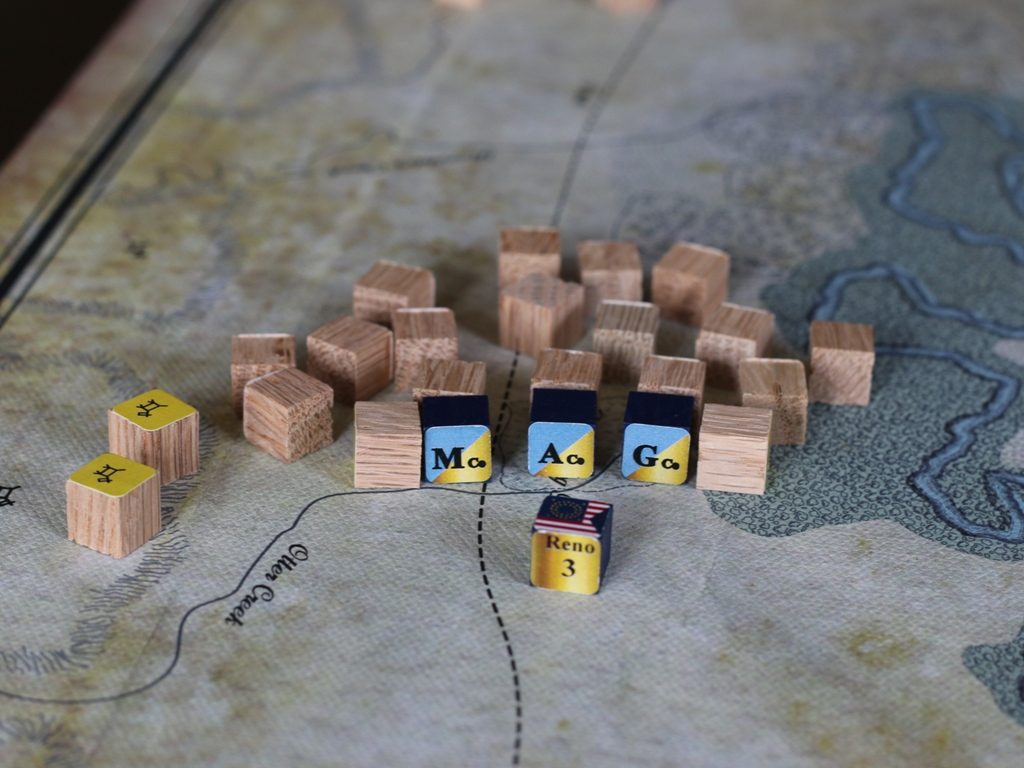
Tactically, the overwhelming numerical superiority usually enjoyed by the Sioux can be deceptive. A careless Indian player who cedes the initiative to the Army can find himself severely punished over the course of two or three turns, reducing his ability to successfully screen the withdrawal of his non-combatants. The Army’s tactical advantage combines with two other factors to enable the occasional Army victory: the Army’s ability to engineer two consecutive moves, and the unique capacity of the Custer unit to attack during the Army movement phase. This gives the Army the ability to open a “hole” in the Indian line with Custer, then move through and attack with other units. This requires the Indian player to maintain a layered defense at all times, as the Army can and will punch through outer layers in the combat phase, then seize the initiative to move immediately in the following turn, again led by the Custer unit. Once a single Army unit contacts (by being fully adjacent to) any noncombatant unit, the game ends immediately (before the ensuing combat phase).

Victory conditions for the game are variable, depending on how many cavalry battalions and tribes are present. Generally, more tribes or fewer battalions makes it easier for the cavalry to win, while fewer tribes or more battalions make Sioux victory conditions easier to achieve.

The key to winning for the cavalry is early reconnaissance to determine how many tribes are present, combined with a flexible strategy to accommodate the level of Indian superiority in numbers, once it becomes apparent. Small numbers of tribes require highly aggressive Army play, while large villages will force a much more cautious approach. Even with most tribes present, the Army has a chance for victory. More tribes means more noncombatants, with will be more difficult to screen effectively against the Army’s ability to combine consecutive moves with Custer’s unique attack capabilities.

An additional – and significant – advantage for the Army is in mobility. All of the Army units except for the pack train and the “Gatling Guns” (ahistorical – Custer left the guns behind, as they limited his mobility) are mounted, while most Indian units are on foot. This advantage is fleeting, however. Once a cavalry company has engaged in combat, it moves dismounted for the remainder of the fight (the Indians have run off its horses). This feature, besides simplifying play, makes it wise for the Sioux player to engage cavalry units early, even with single warrior attacks. The cavalry will almost always win these initial engagements, but will be deprived of their mobility advantage for the remainder of the game.

The mix of Tribes and the varying configuration of the villages makes each game different. The action can shift rapidly from daring cavalry attacks to seize noncombatants and end the game, to desperate fights for survival by encircled Army battalions on isolated hill tops. It is a fun game to play, easy to learn but difficult to master.



Designer’s Notes Antietam

Designer’s Notes


Taking on Antietam was a daunting task. Many people say this battle can’t be gamed. This battle breaks games. The only way to make it work is to tack on McClellan Idiot rules. I hate rules like this. I call them Band-Aid rules: rules that are artificially added to a game to compensate for a fundamentally flawed model. Ideally, we prefer to allow players free reign. Both sides should be able to do whatever they want and operate under the same rules. How can you make Antietam work without Band-Aid rules? What player in their right mind would do what McClellan did?

We started play testing with 2 Band-Aids: The Federals had HQ ratings of 2, while the Confederates had 4. Jackson even had a 5. Even worse, only 1 Federal Corps began the game active: with a chit in the cup. The other Corps would be added to the cup 1 turn at a time. This got us close to a historical result but why handcuff the players like this?

We tightened up the HQ ratings, Federals: 3, Confederates: 4. That is reasonable and justifiable. The ANV had a sleeker and faster org chart. Much quicker to get orders down the line but the advantage is pretty minimal.

Modern historians have been adjusting the previously accepted numbers. The legend was always that the South overcame the odds with brilliant leadership. There is some truth to this but Federal army strengths were often exaggerated. Early reports concluded that McClellan had 100-120k men. Much of this comes from counting ALL men in the Army of the Potomac. Comparing apples to apples, by counting only Combat Effectives, like the Army of Northern V did, this number falls to 90k, 80k, even possibly 75k. This gets us closer to a solution but we are still looking at Lee being outnumbered 2:1.

Another interesting fact we found while researching the OBs, was that much of the AoP was made up of brand new volunteers: 20-25%. These were raw recruits just thrown into the field. Just days before the battle, there were reports of Federal troops having never fired their rifle, not knowing how to load and fire a rifle, not knowing how to change from road column to battle line formation.

The AoP was not the well oiled, veteran machine that the ANV was. It was just recently cobbled together from mixed Corps and many brand new regiments. Many of the officers had recently changed. Days before the battle, Wilcox sent a message up requesting to know who the other Division commanders were in his Corps. Considering this, it is a small miracle that McClellan was able to get the AoP to Antietam so quickly. That’s right. I just used ‘McClellan’ and ‘quick’ in the same sentence.

Surprisingly, this was the only change we needed to make to get Pub Battles to turn out a historical result. We dropped 25% of the Federal infantry to Green status. Not only does it make the game play like the historical battle, it also makes it more realistic and historically accurate. No McClellan Idiot rules. No handcuffs. No Band-Aids.

The only question left was the speed of development. Should the Federals be allowed to start the game with all Corps active and able to attack? Won’t they overwhelm the Confederates if they can?

The answer to this occurred to me from playing Marengo. The French player can often be lured to his own doom IF the Austrian player develops and moves slowly. Why? Because he is persuaded to think that he might be able to defend and hold the line rather than just fall back like they should. This allows the Austrians to bring their artillery advantage to bear.

This is very similar to what the Federals can do with their artillery advantage at Antietam. Sure, you can plow ahead with all guns blazing on all fronts at once with the AoP if you want. You will likely find your fragile, 25% green army quickly shattered.

Surprisingly, to do well with the Federals, you will find yourself advancing cautiously and methodically at a slow pace, much like McClellan! Falling back if things don’t immediately go your way in an assault to rally and make another attempt in a few hours. This approach allows your artillery to pound the Confederates and keeps you from taking catastrophic losses while assaulting over bridges, through the woods and up hills.

This game and Marengo are not Race-the-Clock games. We removed the active Corps restriction. They are more about finesse, maneuver and timing. Don’t worry, there is plenty of time to destroy your army when you are ready.

McClellan actually had a good battle plan. His intent was to advance on Lee’s left with I & XII Corps. Let the rest of the Army sit in reserve, hoping that Lee would commit his reserves to the left. -Which is exactly what Lee did!

With the right timing, Burnside would then launch his attack to bust across the Antietam and cut off Lee’s only route of retreat. Considering the army that McClellan had to work with, it was a good plan. This is exactly the type of plan that is more likely to succeed in Pub Battles.

Now that I’m here on the other side, looking back at what Pub Battles Antietam has become, I am greatly relieved. Antietam did not break Pub Battles. Pub Battles makes Antietam actually work as a wargame. As a designer, this confirms our model and gives us much more confidence going forward to other battles.

If Pub Battles can model Brandywine, Little Bighorn and Antietam without Band-Aids, can it explain battles like Austerlitz? Chancellorsville?

Marshall Barrington


Learn More about Antietam


Order Antietam

Like Old Friends

Ewell, McClaws, Anderson, Hood, AP Hill.  Doubleday, Mead, Hooker, Sedgwick, Slocum.  They almost feel like a bunch of old friends now.  I got this email recently:


“I haven’t played an ACW tabletop game for a few years now. As I was putting stickers on the Sharpsburg blocks, seeing those familiar old names and that amazing map, I really, really got the urge!”


I feel exactly the same way.  Over the years I’ve grown away from my Gettysburg, Stalingrad, Bulge, Waterloo and Russian Campaign roots to other more subtle and exotic pallets.  I haven’t played these campaigns and battles for years.

It is exciting to see these old favorites come back with an all new approach and perspective.  It’s kind of like seeing the all new Muscle Cars come back:  Camaro, Mustang, Challenger.

After seeing the new Antietam, I am really looking forward to the new Gettysburg as well.  The uncertain move sequence alone bring a mountain of tension to the 1st Day.  I have a feeling, it may just be the solution needed to liven up the 2nd & 3rd Day action as well.     

Sailor Trick

I love the cloth storage bags.  I did have a draw string pull too far and ended up inside.  -and yes, they are very difficult to get out. 

I tried tying a knot in the end but that isn’t full proof either. 

Here is a great tip from Yvonne -aka ‘god’:

Instead of tying a knot in the end of the draw strings, tie them both together:

Now they can never slip past the opening. 

This must be one of those Sailor Tricks she learned in the Navy!


Marengo Victory?

Ok, we had a strange Victory result.  The Austrians only lost 1 piece but the French lost 6.  This is a Draw?


Yes, this may seem a little strange but the French had additional forces in the area.  These would have been brought in.  –probably already on the way once they heard the battle.  So the French would have been battered but not broken. 

The Austrians would be forced to retire back to Alexandrie.  They are still bottled up, isolated and out of supply.  They would be soon forced to surrender.

The Austrians must be very aggressive in this game.  There is no Minor Victory option for the Austrians.  You either breakout and win, or essentially you lose.  We haven’t defined a ‘draw’ specifically.  A better description of this would be:  both players lose. 

This isn’t the kind of battle where you can tangle a bit, and then declare a technical victory by scoring a few more hits than the enemy did.  You must crush the enemy and break them.  If you can’t do that, you’ve lost. 

Pub Battles Contest

Command Post Games is giving away 1 FREE Pub Battle game (your choice either Brandywine, Little Bighorn or Marengo) to 3 wise and lucky contestants.  You can find a copy of the Quickstart Rules and Tutorials on how to play on the Brandywine pages but you do NOT need to know the game to participate or answer the question.

Pub Battles is a fast, simple, musket era game that emphasizes command decisions. It can be played in teams with only delayed, written communication during the game between players.  This question is based on a real situation that came up in one of our games!


Situation

The beginning of the battle of Antietam, Sept 17, 1862, 5:30am. Assume historical starting positions. 

You are in command of Hooker’s I Corps with 1 battery of artillery:  The Blue Union Army, the 4 right most blocks.  No one else has moved yet.  Your Corps is first up to move. 

You are playing in a team game. The only communication allowed with other players is through written messages that suffer a 1 turn time delay before you can read them. 

Your starting orders read:

“March SE down the road to attack the enemy at Mercerville.”


The Question

Mercerville is to your right and directly West. Marching SE is in the opposite direction.  What is your best course of action?

Answers


  1. March SW and attack the 2 Confederates to the West near the river. (far left)
  2. Write a letter to President Lincoln, asking him to remove McClellan from command for incompetence and give the Army of the Potomac to you.
  3. March West into Mercerville and then await further orders.
  4. Release the Hounds.
  5. March SE and attack the Confederate position just south of the East Woods. (far right)
  6. Invite your staff to join you in a relaxing game of croquet.
  7. Make no moves. Send a written request for clarification of your orders & hold your position until you hear back.
  8. Give the messenger your personal compass and tell him to take it to McClellan.
  9. March SE and attack the Confederate position in the West Woods. (center)
  10. Advance and attack all enemy positions at once.
  11. Sigh and open a new bottle of whiskey.
  12. Other?  -describe

How to Enter

Simply email your answer to:   god[AT]commandpostgames.com


Rules

You may only answer once.

Employees and relatives of employees may not participate. 

Answers will be reviewed by an independent panel.  All best / correct answers will be put in a pool and randomly pulled to determine winners. 

International contestants are welcome.

We will send the winners a FREE Pub Battles game.  The games do not include measuring sticks.  We do ask you to pay shipping.  We will send you a PayPal invoice for this. 

Entries must be received August 11th through 31st, 2017. 


Marengo in Minis

Pub Battles is a mixture between wargame and miniatures.  I’ve been meaning to get set of minis to use for Pub Battles, just to see how they look.  Somebody beat me to it!!

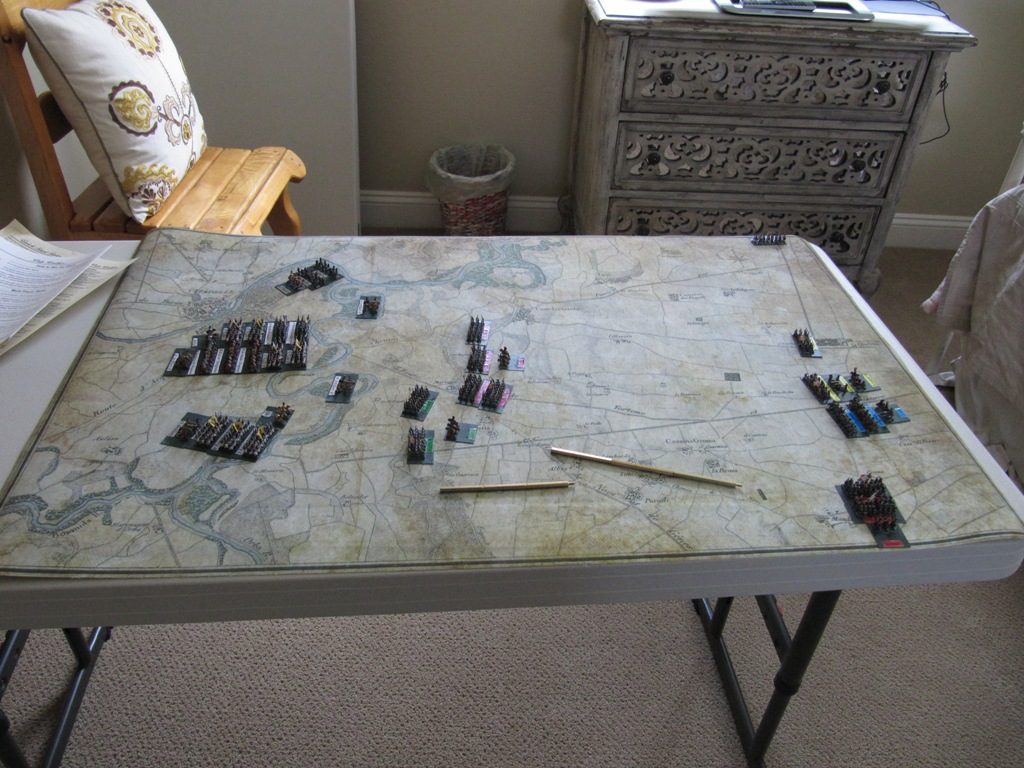
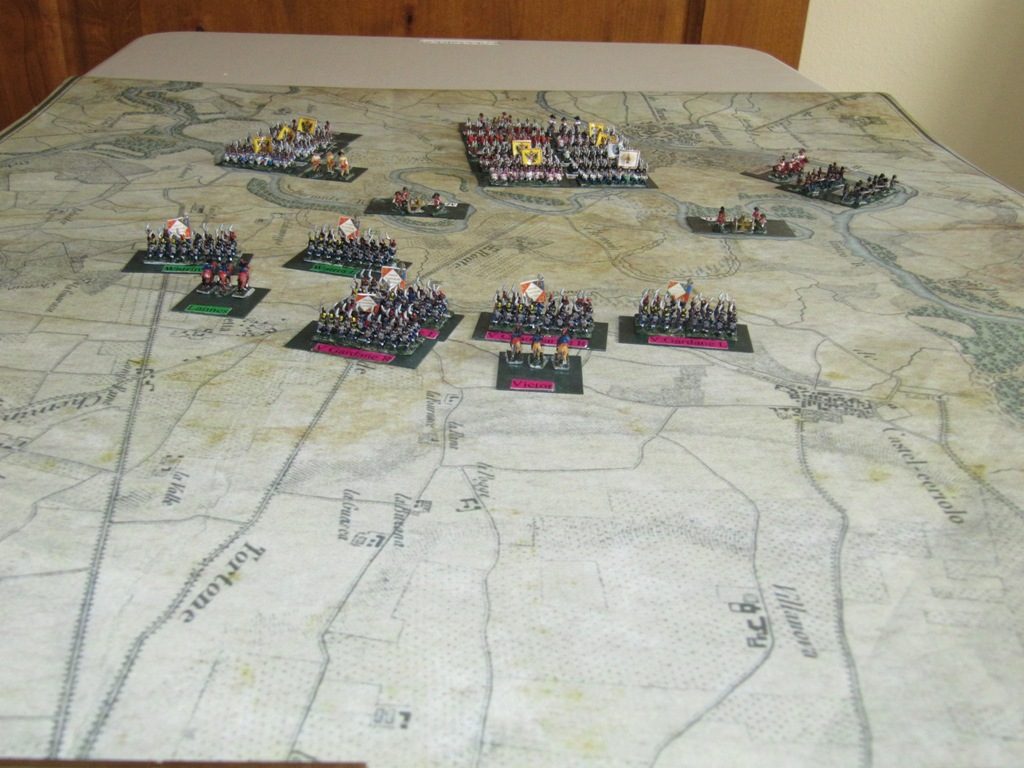
Check it out.  They are all set to Pub Battles scale and everything.