Sun Tzu at Brandywine

“To unfailing defend, defend that which is never attacked. To be unfailingly victorious when attacking, attack that which is never defended.”


How would Sun Tzu command the Colonials at Brandywine? Are there any lessons here we can learn from his wisdom? 

Washington came up with a plan. He prepared for the British attack.  Sun Tzu would say this is a mistake.

 “Do not attack the enemy.  Attack the enemy’s plan.”  

Attacking the enemy’s plan is exactly what the British did. How could Washington have attacked the enemy’s plan?  He couldn’t.  He had a failure in intelligence.  He didn’t understand the true enemy’s plan until it was too late.  At the real battle, Washington was caught by surprise.  He deployed assuming the enemy’s approach.  This is why Sun Tzu strongly emphasizes intelligence gathering.  If you don’t know what is going on or what the enemy is up to, how can you attack his plan? 
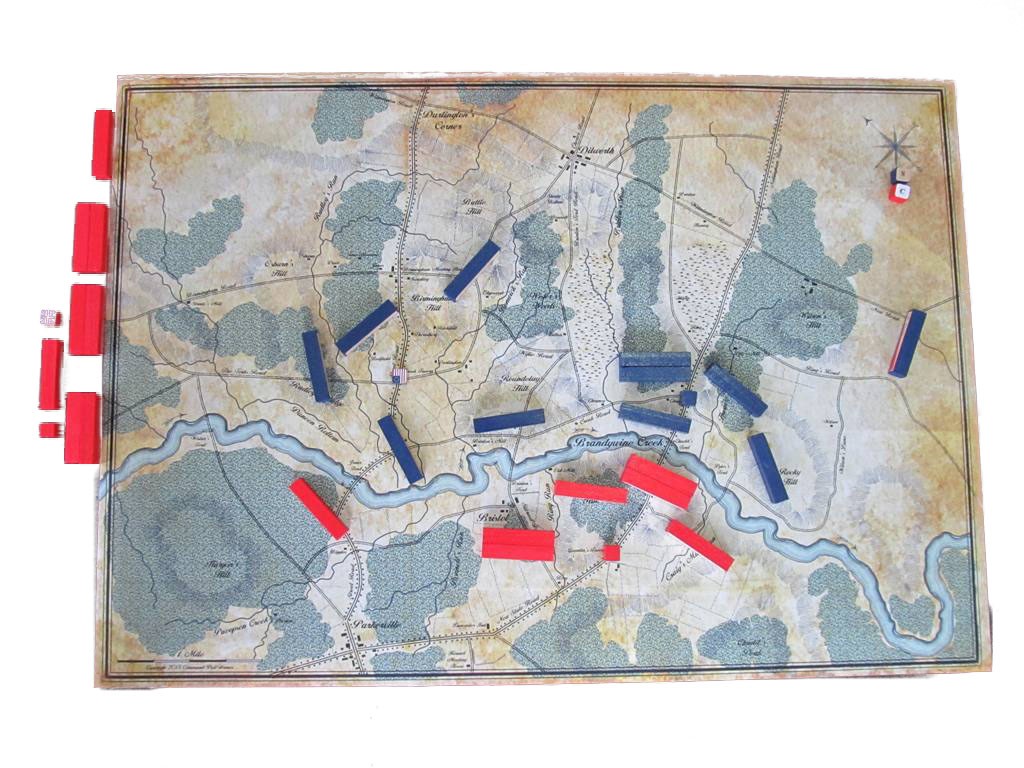
How can you re-create the element of surprise in a game? You have the historical map.  The historical OB.  The British are flanking.  There is no surprise to the player in most games like this.  Often times games like this come with ‘bandaid’ rules.  Rules that handcuff players and force them to do stupid things.  Force them to sit for several turns of delay before they can respond.  Other games on Brandywine force the Colonials to setup historically.  They begin the game badly out of position.  This is not so in Pub Battles.  

Remarkably, the Colonial player is free to setup anywhere he wants. Free to have any plan he wants and react immediately.  How could that work in a game?  Wouldn’t that doom the British to an automatic defeat?  No.  This is something Pub Battles pulls off remarkably well.  The Colonials are truly surprised.  How?  Because they must setup first.  The British setup second and can enter on either flank.  As a result, the British can ‘see’ the Colonial plan and then attack it! 

This does an amazing job of recreating the historical sense of panic and urgency in the Colonial player. The game starts off and feels like a scramble for survival.  This is what the battle really was.  It is recreating the historical feel.  What can the Colonial player do?  This is a significant handicap.  Can the Colonial player ever win?  How should you setup?

First of all, if intell is your biggest concern, what can you glean from the British Wing deployed on board? Where are they?  What is there intent?  What does that tell you about where the flanking wing is likely to attack. 

I feel it is a mistake for the Colonials to setup committed to any specific course of action. You are supposed to be receiving an attack.  Not launching one.  You do at least have the foreknowledge that a surprise flank attack is possible and in fact very likely.  Also consider that you have a massive intell failure.  Where is the enemy?  Where are they coming from?  Before the game, you have no idea. 

How can you ‘attack the enemy plan’ if you don’t even know what that is? In this situation, I think Sun Tzu would say: Be mysterious and formless. Gathering intell is your first mission.  How do you setup before you have any intell?  In a mysterious and formless void.  Napoleon liked the central position.  This is a position of power.  This situation calls for the bulk of your forces to be held in a central reserve, surrounded by a thin, delaying screen for recon.  All roads should be blocked to prevent a rapid road march deep into your interior.  More cavalry would be helpful but you only have 1. 

Think about this from the perspective of the British. How do they attack your weakness?  There is none.  You’re just a big scattered blob.  They might as well just flip a coin to decide where to attack from.  Wherever your central reserve is, make sure it is on roads so that they can rapidly respond to the flanking threat. 

Which force should you use as the reserve? This is a dilemma.  Washington’s force can react quicker.  –If using the RPWG, Washington can move immediately without waiting to receive written orders.  This is a nice advantage but Washington’s force includes the Cav, Militia and Artillery.  Greene’s force is larger and contains more brute force.  Which is better? 

Many players want to attack with the Colonials. It may feel good but remember, you aren’t there to defeat the British and win the war in 1 battle.  You’ll be lucky to survive.  Keep the victory conditions in mind.  To ‘win’ you don’t have to beat them.  You have to delay their advance (by holding the major roads) and save your army (maintaining a reasonable balance of losses). 

Keep losses in mind while fighting. This is a common mistake I see Colonial players make.  You want to WIN!  You want to beat the British and throw them back!  The battles can be very exciting.  You take a hit.  The British lead piece doesn’t but it’s not an elite.  You don’t want to run away.  You want to hold the position.  You want to WIN right? 

You want to win the battle, NOT this particular combat. Do you have to win this fight?  How critical is it to winning the battle?  If your lead piece is flipped but the British lead is not, there is a much bigger chance that you will lose that piece if you fight another round.  That will cost a VP.  What is the current VP count?  Can you afford that loss?  If you retreat from this fight, can you still have a reasonable chance of holding the major roads before the battle is over?  All too often I see Colonial players losing points on casualties over battles they ‘want to’ win, not ‘have to’ win. 

How do YOU play the Colonials? What is the best setup?  What is the best defense?  Do you have a favorite?  What seems to work the best?  What works very badly?  Share your thoughts here!


French Strategy Guide for Marengo

Lessons From Marengo

What does it take to win in Pub Battles? What skills are rewarded by the system?  Play testing this battle has given me keen, new insights into not only this battle but the entire Pub Battles system.   


New players often fight every round possible until they either win or are destroyed. If you do this, you are leaving the game up to fate. You can mitigate much of the luck factor by exercising good discretion. Remember that additional rounds are OPTIONAL. Before you agree to fight another round you need to ask yourself some very important questions:  This is especially critical for the French early on. Initially, they only have 6 blocks to stop an entire Austrian army of 18 blocks. EVERY piece is critical. What is the best you can accomplish by staying a 2nd round? You might kill an Austrian piece and delay the Austrian advance for a turn. So what? If the Austrians drop to 17 blocks against your 6, that won’t hurt them much. What happens if you lose? Now you only have 5 blocks to stop 18. That is WAY too big a risk to take. You must fall back. You don’t have to win every fight. Keep your eyes focused on winning the battle. Walk away. There will be a better time to fight.

How critical is this particular fight? How important is it to the battle? How badly will nearby units suffer if this ground is lost? What is the current force ratio? Every loss is critical. If you lose 1 more piece trying to stay in this fight, how will this impact your army as a whole? Will you still be able to face the enemy across the field effectively if you lose this piece (or pieces)? You have to carefully examine your risk/reward ratio. What do you stand to gain vs what you stand to lose?


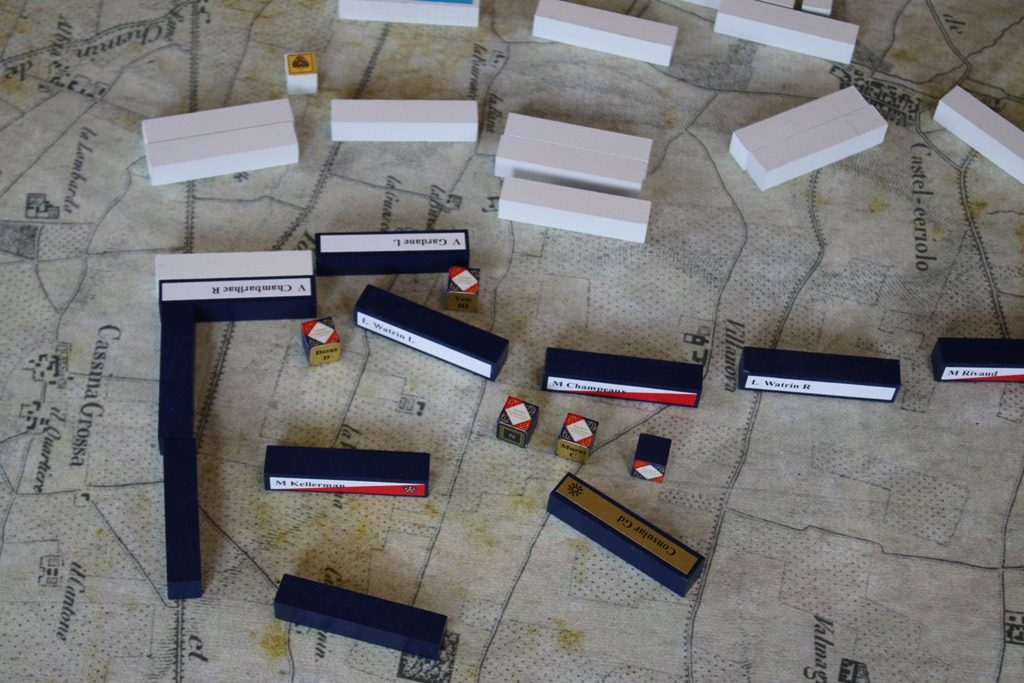
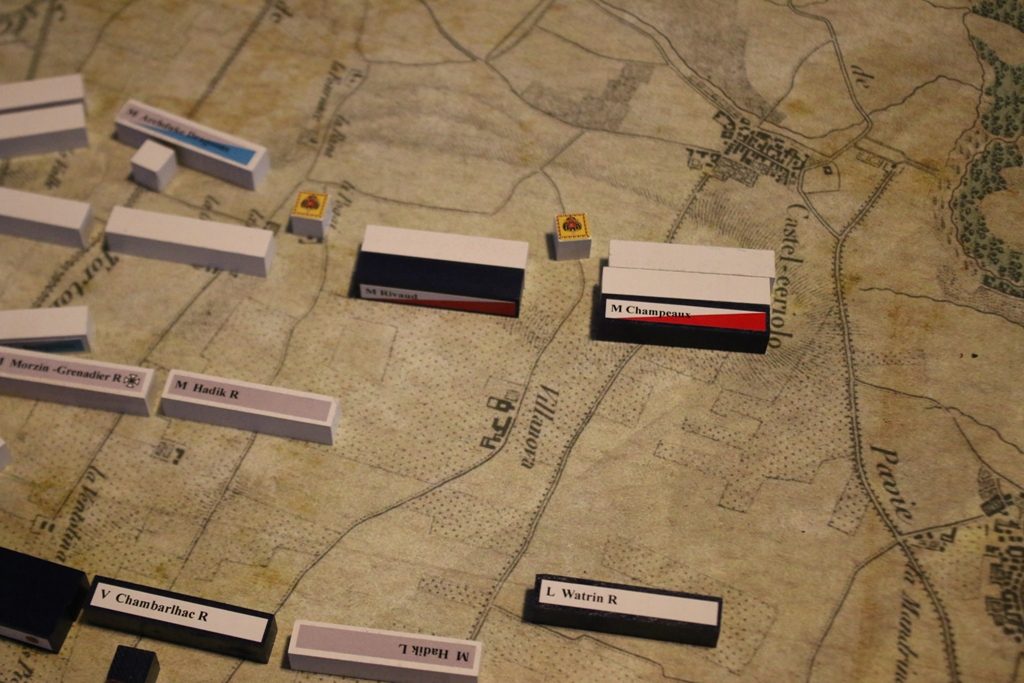
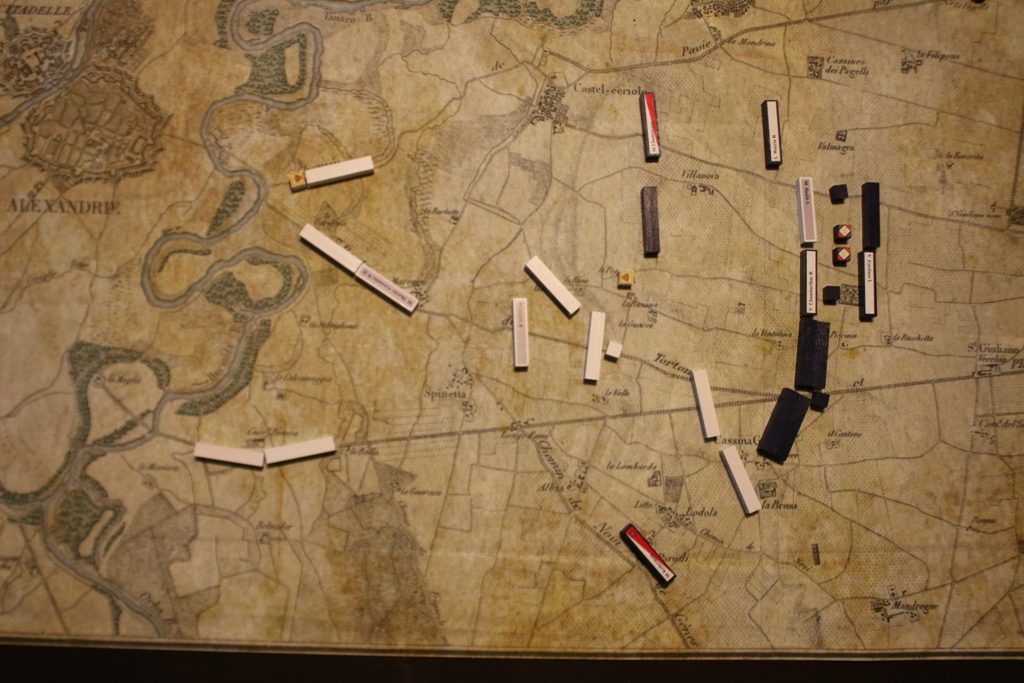
I love the clear open terrain at Marengo. I love the huge force disparity. It really brings the fundamentals of maneuver, force and position into focus. You might be wondering how 6 blocks can fight 18. Note this picture from a historical opening:


The Austrians have just crossed the river. Yes, they have 18 blocks but most of them are bottled up behind lines in a traffic jam. How many blocks can they present to the front? Only 3. How many blocks can the French present? 3. There you go. Those 18 blocks don’t matter. They cannot be brought to bear.

Now the French must fall back at some point to prevent losses, as previously discussed. As they fall back, the Austrians can expand the front and bring more forces to bear. Fine. What can the French do then? Fall back again. Falling back prevents your flanks from being turned. It prevents the Austrians from being able to bring their power to bear. You trade ground for time. You also greatly limit the damage the Austrians can do to you. Those 18 blocks mean nothing if they can’t get a hold of you or do any damage.

Another interesting result of running, is that it virtually negates the massive Austrian artillery advantage. As you fall back, the Austrians race to keep up. The guns fall behind. They are almost always out of range to fire. If they can’t fire, they might as well not be there. Perfect.  


While monitoring your force ratio with the enemy, you should also keep an eye on the number of spent units.  What portion of your army is fresh vs spent? How does this compare to the enemy?  Ideally, you would like to see a mostly spent enemy army vs your army that is mostly fresh.  This is a position of strength and power.  The French will likely find themselves on the weaker side of this curve.  That’s ok.  It just means that now is not the time to stand and fight. Fall back and as you do, try to get some portion of you army back on line. In the mean time, try to flip a few Austrians along the way. Remember, they can’t rally either while they are pursuing you.


Desaix’s arrival is more important than it seems. He only has 2 blocks to reinforce with. That may not seem like much but it is likely all it will take. Have you ever spotted a weightlifter? Have you seen how little force it takes to help him lift the last rep that he can’t do on his own?


By now with some luck, you have picked off a few Austrians with judicious Cavalry and Guard charges. The Austrian army is now spread out and thinned. If you listened to me and didn’t squander several blocks to stubborn, unnecessary fights, you should be getting close to parity. It may not look like it but always remember: 4 of those blocks back there are artillery. You will run those down easily once you break this line in front of you. You also don’t even need ‘parity’. Remember that you have the Consular Guard and Murat’s Cavalry. Those units are easily worth double their number of Austrians.  


Marengo teaches you a keen sense of timing. There were many times with the French I wanted to strike back. I wanted to attack and halt the relentless Austrian advance. I could have but it would have cost me the battle. You have to charge when the enemy is spent.

There were several turns I wanted to charge but I didn’t get the timing sequence I needed. The Cav missed their roll then bam, the Austrians rallied. The door of opportunity shut before I could strike. That is ok. Bide your time. Have patience. Wait it out. Keep your Cavalry ready to charge. They should be fresh and positioned behind lines to strike anywhere along the enemy line. This alone should force the Austrians to slow down and advance with caution. The Austrians won’t get lucky on timing every turn. Eventually, you will get the right timing sequence. The Austrians will be repulsed and spent. Your Cavalry will get the next move. Imagine the damage your Cavalry could do with a double move turn sequence! You could shatter 3 spent Austrian infantry, THEN charge again hitting 3 artillery behind lines! That is 6 kills in 2 successive moves.


This illustrates why exactly patience will pay off. It only takes 1 or 2 breaks in timing to crush the Austrians and win the game. This won’t work if you insist on attacking when YOU want to. You must wait for the right time to arrive. I can’t find the exact quote now but I remember Napoleon describing the critical timing moment in battle when victory is achieved. He said it was like adding the last drop of water that causes the dam to overflow and break down.


“This is why it is said that victory can be seen but not made.” -Suz Tzu  

Disaster at Little Bighorn

This is our first After Action Report, from a Backer on Little Bighorn.  It was a DISASTER!!


The game took 1 hour, including sorting out all of the little cubes, glancing at the rules, and then playing the entire game.

He took Custer and a fake Mathey north along the ridge (hoping to draw me toward Custer, as he told me later), while Reno and Benteen came across the river straight at the villages.  I sent two of my nations straight at Reno and Benteen, while the 3rd nation escorted the NCs toward the edge.

Reno and Benteen ran into bad luck.  As he realized afterward, he advanced too far from a good crossing place and then frontally charged my line. He forced most of my line to run, but killed only one, while I forced a couple of his to retreat, creating holes in his line.

Next turn, Reno went first, and began to pull back, but then I went next, and he failed Benteen’s roll. I swarmed behind Benteen and trapped a couple companies.  I then realized Custer was on his own and the 3rd nation moved straight toward Custer. The NCs (Non-Combatants) were all able to flee off the board.

Meanwhile, by the time Reno and Benteen were able to get to the river, they had both lost half their companies.  Warriors then poured across the river and trapped some of Custer’s companies and he ran back to join the remnants of Reno and Benteen.

He decided afterward that was perhaps a mistake.  By the time he decided to circle on hill tops, the damage was done.  He lost 9 of the 14 units, and the Natives lost about 9 units.

It was a disaster, and we laughed through the whole game!  It was just plain fun!

Mark


If you can scrounge up another few players, it gets even more fun because you can only ‘communicate’ with other players if your HQs are touching.  Intense and hysterical. 


Why Move?

I was teaching a new guy to Wargaming recently. I noticed a strange phenomenon.  It’s not just him.  I see veteran players do this also.  What did he do?

I noticed that every time he moved, he moved the maximum distance possible. He pushed it EVERY time.  I had to constantly watch and police him.  He kept trying to nudge each piece just a little further. 

I even noted that he wasn’t in a hurry!   There was no reason for him to be moving fast.  There was no urgent tactical or strategic crisis at hand.  No benefit to be gained from going a little further. 

It is strange when you think about it. Why do we do this?  Have you notice this in your play?  Do you and your friends do it too?

Identifying Unit Types

We started Pub Battles with cardboard counters.  We switched to blocks later for ease of use.  They are easier to grab and flip around.  We also loved the look once we saw it. 

We never really intended them to be used for hidden intelligence.  When the piece is spent you can see what it is.  You can also see what it is if it is facing away from you.  It can happen. 

Units could be spotted from about a mile out.  On a dry, clear day with dirt roads you could even identify the unit type (cav, inf, art) and size out further by the dust cloud shape formed by marching. 

Once on the field, I’m thinking you should be able to identify at least the unit type at a certain distance IF it can be spotted. 

Should we clarify this in the rules?  What exactly should the rule be?   What are your thoughts?


Umpireless Kriegsspiel

Designer’s Notes -Pub Battles


One of our main design goals, that we haven’t talked about much yet is the Kriegsspiel intent. Yes, the maps and pieces look ‘kriegsspiel’ style but what does this game really have to do with Kriegsspiel?  It is just a quick, easy 2 player game. 

Actually, it has everything to do with Kriegsspiel. Much of this design is aimed at solving key problems in Kriegsspiel.


Kriegsspiel Problems

  1. Slow Game speed and player interaction. 10 players and 1 Umpire, means there can be a lot of time sitting around waiting to hear something new as a player.
  2. Lack of Players. In our hobby, it is often hard just finding 1 player. Now you have to find 4-10. On top of that you need at least 1 Umpire. Preferably more! A friend of mine who runs Kriegsspiel games regularly, likes to see a 1:1 ratio in Umpires to players. Ideal I agree but good luck.
  3. Player detachment. I see this effect a lot in computer games too. It is almost like the computer gets to play the game and I just sit and watch. What is going on? How does the combat work? How could I have lost that engagement? I should have won. Did the Umpire roll a 1 for me? Can I roll my own dice? I think players like to know what is going on. They like to see it. At least if I roll a 1 and I watch my opponent roll a 6, I know why I lost. It happens. A brief whining phase then we move on.
  4. Overly technical rules. The original Kriegsspiel rules for combat are a great piece of history that document real world experience of combat in 1824. For actual game rules they are slow and tedious to execute. This extra drag time on the Umpire makes the game even slower for player interaction. If you are a junior officer ordered to participate in a training Kriegsspiel that is ok. If you are trying to convince friends why they should play this game with you for the afternoon, it is a big problem.


Umpireless Games

So what is an umpireless game? How does it work?  In a big battle, you would have 3-6 player teams running each Command (usually a Corps).  They all sit at the same table with 1 map.  They can all see everything.

Yes, we lose a little of the hidden intell effect but consider this: The players can’t talk to each other.  Also that the Army Commander does not sit at this table.  He cannot see any of this.  The guy in charge sits at a separate table with separate map.  All he knows is what his Corps commanders tell him in written reports that are delayed.  There is your hidden intell with no Umpire. 

Besides from my experience in command, the hidden intell is the least of your trouble. Even if you had perfect intell, the much bigger problem is getting your people to do what you want and getting them to report back and tell you what is going on.

As a Corps commander, if I am ordered to attack Little Round Top, what difference does it make to me what is happening at Culp’s Hill? That doesn’t concern me much.  I’m busy watching and fighting with the enemy in my sector of the line.  I might be aware that there is a lot of fighting going on near Culp’s Hill.  In a real battle I could hear that too.  So what?


Pub Battle Solutions

So how does this format in Pub Battles address the Kriegsspiel problems?

  1. Slow Game speed and player interaction. Pub Battles plays in 1-2 hours. If you add more players in teams it will slow down more but still you can complete an entire big battle in 2-4 hours. Try that with traditional Kriegsspiel.
  2. Player interaction is much better. Note that if my Corps is not currently engaged, this gives me something to do as a player. I can watch what is happening. I can write to other commands and to my commander, to report and urge them to action. The game is still fun and I still have a level of participation and engagement.
  3. Lack of Players. No Umpires needed at all. We’ve also cut the rules down to size. The Quick Start rules fit on 1 page! You are also playing in teams. This makes it very easy for new people to play. They can just jump in and learn by playing. It is much easier to get non-wargamers and even non-board gamers to give it a try. This greatly expands the potential player pool.
  4. Player detachment. The players can actually see and move their own pieces. They can resolve the combat. This increases player engagement but still preserves Fog of War and Hidden Intell, because Army Commander doesn’t know any of this. It has to get reported back and that’s where all the trouble (and fun) starts.
  5. Overly technical rules. When you gather 10 non-wargamers together to play an Umpireless Kriegsspiel with you, SPEED is critical. The game has to be fun and fast moving. We based the Pub Battles rules off the core Kriegsspiel data. The goal was to boil all this down into a quick, simple system that returns the same essential results for movement and combat. Yes, we lose some of the detail and options but the speed gained is worth it!


Small Army vs Large Army

How does a large army with many small Corps differ from a small army with a few large Corps? Antietam is a great example of this. The Federal Army of the Potomac had 6-7 small Corps. The Confederate Army of Northern Virginia had only 2 Corps but they were large. What impact do these different command structures have?

Many of these differences become clear in the Pub Battles system. Each Corps has a chit. The Corps move in random order as you pull these chits from a cup. HQs can attempt to alter this random sequence by rolling a die. You can attempt to move first by jumping ahead of the current pull, OR delay your move by returning your chit to the cup.

The Federals must roll 1-3 to be successful. The Confederates are more likely to pull off the timing they want as they only need 1-4. This isn’t to say that all the Confederate officers were better. It is more a reflection of the command structure. The Potomac had more Corps and more command layers. It stands to reason that it would take a little longer for their orders to actually get people moving.


Ok, so how does all this actually impact game play? Who has the advantage? The big army with lots of Corps or the small army with few, large Corps? Here is a quick analysis:

Case 1

Big army wants to attack little army all up and down the line.  They can’t just advance everybody at once to engage.  They can only advance 1 small Corps at a time.  This will leave openings and gaps in the line.  The little army should be able to move in between these moves and cause all kinds of chaos and awkwardness. It is easy to catch them with 1 foot over the barrel.

Advantage:  Small Army

Case 2

Little army wants to attack big army all up and down the line.  With a little luck and timing, they most likely can pull off a coordinated attack all up and down the line at once. 

Advantage:  Small Army

Case 3

Traffic jams!  You are trying to relocate a big portion of your army.  This can easily result in traffic jams for the Big Army.  If you can’t pull in the right sequence, several Corps will be held up waiting for the ones in front of them to move.  This tends to make Big Armies slow and lethargic.  Sounds a lot like McClellan doesn’t it?

Advantage:  Small Army

Case 4

Let’s say it’s time to bug out.  All hell is breaking loose and you just want to flee.  This is like the big coordinated attack all at once, only in reverse.  If you can’t move in the right sequence, some Corps will get stuck.  Others will be in the way.  Which ones are fighting a rear guard action?  This can become a huge nightmare.  Especially if the Small Army can very likely jump in and strike at the worst possible moment.

Advantage:  Small Army

Case 5

The Big Army does have more flexibility and a slight advantage in numbers.  Antietam is a good example.  Let’s say the Federal artillery bombards a Confederate Division in the Sunken Road.  The Confederates flip and run.  Now who moves next?  This is critical.  The Federals have more chits in the cup.  So they have better chances of getting pulled first to occupy the Sunken Road before the Confederates can. 

There is also a good chance that the Confederates already moved for the turn.  Their whole army is concentrated in 2 Corps.  What if they got picked early in the turn?  They delayed but then got picked again?  That is half their army that has to move early.  Good chance they won’t be able to scramble back into the Sunken Road now. 

The Federals have 6-7 Corps.  Much better chances at getting one of them picked to move first.  This seems like a huge advantage but not so fast. First, consider that most of those Corps can’t actually get to the Sunken Road.  They are scattered around the field.  Maybe only 2 or 3 of them can actually get there.  Also, remember that some of those 2-3 Corps may have already moved.  

Advantage:  Slight advantage to Big Army.  Not as big as you might think.


So at Antietam, these 2 armies are going feel very different. They will require a completely different approach and strategy. There are going to be many other things to consider in your moves. I like how none of this requires any new rules. It is already built into the system.

It is going to require a little more thought, a little more time. It is more complex but the complexity is in strategy, planning and decisions, NOT in learning and remembering more rules. I like complexity in command decisions. This is complexity well spent on a game design. Not complexity in how units technically move and fight. Not in looking up results on tables of data.

This complexity is spent pondering timing effects related to command and how that can impact battle results.  These are decisions related to command.

This is what we are all about.

How Important is Victory?

I’ve notice many times that players never even look at the Victory Conditions for a game.  Do Victory Conditions in the rules even matter?  What would you think of a game with No victory conditions?  Is that completely crazy?  Is it even possible?  Here is my case:


Often times, players don’t even bother to lookup the rules for Victory.  I’ve seen this in many games.  They just setup and start playing.  Most games never even go to the end.  About half way through, one player usually gives up and concedes.  Game over.  They lost.

Players seem to have an intuitive sense for Victory.  They can tell.  They know when the lose.  They know when they win.  Both players usually see this at the same time and they are usually in agreement.  I don’t remember ever seeing players argue over this, where both players believe they have won at the same time.  I do see them argue over the meaning of rules. 

We usually love to discuss the outcome of the game afterwards.  This is often our favorite part.  It usually goes something like this:  “Well, looks like you won.  You really surprised me with this move.  I didn’t see that coming and then I got bad luck over here.  I did pretty well containing you here under the circumstances but in the end it wasn’t enough.  Good game!”


We like to talk about our brilliant moves and colossal failures.  Where did the game change?  What was the most important event or decision?  What were you thinking when you did this?

I don’t see players argue with each other but I do see them argue with the Victory Conditions in the game.  Often times they are at odds with the game rules.  How many times have you heard:  “Well, technically you won according to the rules but in the real war, I would have won!”  OR “You are winning now but IF we play 1 more turn, you are going to get stomped!”

This kicks off a very interesting debate on what happened in the real campaign / war and how the game events differed.  How would these differences would have altered historical events afterwards?

I’ve noticed that players consider many subtle factors and variations in these discussions.  They take into account far more information than any game rules on Victory Conditions could.  Could you imagine a separate 100 page, fine print rule book on how to determine Victory after the game?  How would the game results have impacted army morale later?  Public opinion on both sides?  The political impact on parties, elections and legislation?  Economic performance and production?

Yeah, yeah, yeah, or you could just look at the board and say:  “I think you won.”  For me, this is often the best part of the game:    Discussing and debating the outcome of the game.  Who won?  Imagine how history would have been different with this result.  Preferably over some cold beers.


Could you have a game like this?  Are there other views?  How important are Victory Conditions to you and your friends?  Would you play a game that had No victory conditions?

Capture Those Colors

Pub Battles works great for scrappy little battles like Brandywine and Little Bighorn.  Is that what this system was built for?  Is it capable of modeling bigger engagements like Gettysburg or Austerlitz? 

This is a great analyses by Mike Strand.    -And by the way, we have pieces for Gettysburg and started on the graphics for the map this week!  I would expect to see this out sometime next year. 


The way many folks talk about Gettysburg, you’d think it was a fait acompli that the union would win, yet there are those who also maintain the 1st Minnesota “saved the union.” This dichotomy creates a real problem for game designers. How do you make the game realistic in the sense of what could the participants have realistically expected from various actions, and then factor in such unpredictable variables as the case of 264 man battalion charging a fresh 1400+man brigade and stopping them cold. 


One way is by just ignoring such anomalies and saying “well this game doesn’t count actions by smaller units.” Another design technique would be to include a deck of cards, one card would be the 1st Minnesota card that allowed a combat re-roll. Unfortunately, having the card be a known quantity that a player can lay down at any time is too powerful.


Now look how this plays out in a Pub Battles game. The Union has a bunch of spent units that have just retreated off Seminary Ridge and some fresh units behind those. The confederates facing them are all in good order. Whoever moves first will decide whether or not the Confederate player rolls up the Union line or not. The confederate command chit is drawn first, the union player rolls for his divisional commander to alter turn order…Fail! Next he rolls for his corps commander, success! The union spent units rally to fresh and the confederate attack is repulsed when Picket’s division is chewed up by a couple of the union units rolling 3 hits.


What happened historically? The corps commander, General Hancock, was trying to move up his fresh brigades to fill the hole in the union line, but Wilcox’s Virginians were already closing in, a 1400 strong fresh brigade. He had to delay them just a few minutes. Looking around, he spotted the only unit available, a Battalion of a couple hundred Minnesotans. He rode up to their Lieutenant and pointed to the Virginian’s colors. He said simply, “I want you to capture those colors.” The lieutenant said, “Yessir!”  The little Battalion surged forward and captured the colors before being repulsed with 83% casualties. The delay was time enough for Hancock to move his troops into position. The line and the Union was saved.


Pub Battles does not try to recreate the heroics of the 1st Minnesota directly, instead it creates the same results with a player’s decision to involve the corps commander directly, and with a die roll showing how successful he is.


Simple. Elegant. Brilliant. 


-Mike Strand


Speed Supremacy

The economics: trade, loans, bonds, resource cards, market etc are fascinating.  This is one of the most remarkable things about Supremacy.  They make an incredible model of world trade.  All of these things however add a lot of time to play.  Sometimes, we just want to fight!

These rules dramatically speed up the game. All the economics are cut out and streamlined.  It’s all boiled down to just attack and build. 

With everything stripped out, the Victory becomes much more clear. It is all about growth.  If you sit and build, your score is ZERO.  You must attack. 


Setup

Each player should start with their regular forces but no money.

Produce

Ignore all Salaries for your companies.   Everything is now free!

Blockades and Seizures work the same.

Income

Instead of producing resources, just collect $100 BL in cash for each resource you have in cards.  


For Example, if this is your total cards:         3 Min    5 Grn    3 Oil

Your Income would be:  $300 + $500 + $300 = $1,100 BL


Trade

There is no Trading, Loans or Bonds. 

Instead of Grain, spend $100 BL in cash to Feed every 10 armies / naives.    

Combat

Instead of paying resources to move and attack, pay $200 BL cash for the regular 3 moves / fires.  The Defender must pay $100 BL for a committed defense.   

Redeploy

Instead of paying resources to move, pay $100 BL cash.


Build

Building now only requires cash, no resources:

Army / Navy     $100 BL

ICBM                $500 BL

ABM                 $1,000 BL

You must still research to get new Company cards and build ICBMs & ABMs. The cost is the same:  $200 BL per card you turn over.

Ending the Game

Record your starting production at the beginning of the game.

Your total score is:

Total Ending Production – Starting Production