Like Old Friends

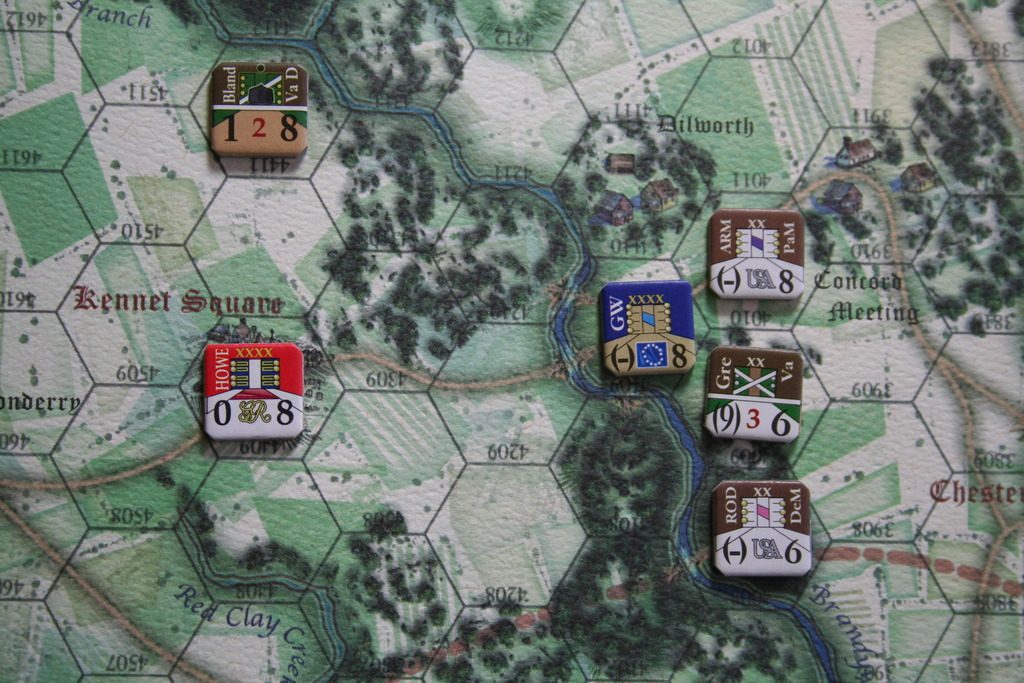
Ewell, McClaws, Anderson, Hood, AP Hill.  Doubleday, Mead, Hooker, Sedgwick, Slocum.  They almost feel like a bunch of old friends now.  I got this email recently:


“I haven’t played an ACW tabletop game for a few years now. As I was putting stickers on the Sharpsburg blocks, seeing those familiar old names and that amazing map, I really, really got the urge!”


I feel exactly the same way.  Over the years I’ve grown away from my Gettysburg, Stalingrad, Bulge, Waterloo and Russian Campaign roots to other more subtle and exotic pallets.  I haven’t played these campaigns and battles for years.

It is exciting to see these old favorites come back with an all new approach and perspective.  It’s kind of like seeing the all new Muscle Cars come back:  Camaro, Mustang, Challenger.

After seeing the new Antietam, I am really looking forward to the new Gettysburg as well.  The uncertain move sequence alone bring a mountain of tension to the 1st Day.  I have a feeling, it may just be the solution needed to liven up the 2nd & 3rd Day action as well.     

Supremacy Turn Variant

Games where you do everything at once (trade, move, attack, build) and then the next player goes are considered old school.  The downside here is that you have to wait a long time before you get to do anything.  Especially if you are playing a game like Supremacy with lots of players. 

The new way is to break this up into smaller phases where everybody plays together.  So, each player trades.  Then each player moves.  Then attack, etc.  This helps keep players involved and participating in the game more frequently.  The new Supremacy 2020 follows this format but this method isn’t always good.  There are down sides to it. 

In many ways, Supremacy works better with the old school method.  This is how you can easily Retro Fit your Supremacy game with old game tech:


Combined Turn Sequence

Salaries

All players simultaneously pay salaries and collect new resources, etc. as usual. 

Player Turns

Randomly determine the next player to go by pulling chits as usual.  During your turn, you Trade, Combat, Redeploy and Build all in sequence.  Once you have finished all Steps, draw a new chit to determine the next player to go. 

Note that launching Counterattacks, can still draw you in and give you something to do during another player’s turn.


Advantages to Using this Variant

Better Strategic Planning

A downside to playing together in broken down, incremental Steps is that it is hard to create and implement a coherent strategic plan.  Everything is always changing.  Often times your plan is ruined by time you get to move.  It is almost better not to make any plans until it is time for you to do something.  This variant allows players the time they need to think and operate more strategically.  This is a much better fit for Supremacy. 

Social / Diplomacy

In many ways the best part of Supremacy is the diplomacy:  alliances and negotiation.  With the new rapid fire format, there is almost no time to conduct this effectively.   Instead of sitting around bored, waiting for your turn, this time gives players the perfect time needed to conduct diplomacy.  This also gives you more time to socialize.  Bringing people closer together to bond and connect is what games are about.  Go with it and enjoy!   

Teaching / Policing

Are people cheating?  It is harder to track this and enforce the rules if everybody is moving at once or in rapid sequence.  If you are the only person moving and everybody else is watching, you have to be on your best behavior.  If you are a new player, this is a great time to learn and get coaching advice from other players.  Players are usually too distracted to help in the current system. 

Faster?

This may be counter intuitive but I suspect that the game will actually play faster this way.  At the very least you are saving time by only pulling chits once per Turn, not every Step.  I think players will also spend less time ‘thinking’ during their turn time.  They have plenty of time to think while other people are moving.  When they get pulled, they know exactly what they are going to do.  They just jump right in and crank out their whole turn at once. 


Try this out and let us know what you think.  Do you like it better?

 

Sailor Trick

I love the cloth storage bags.  I did have a draw string pull too far and ended up inside.  -and yes, they are very difficult to get out. 

I tried tying a knot in the end but that isn’t full proof either. 

Here is a great tip from Yvonne -aka ‘god’:

Instead of tying a knot in the end of the draw strings, tie them both together:

Now they can never slip past the opening. 

This must be one of those Sailor Tricks she learned in the Navy!


Marengo Victory?

Ok, we had a strange Victory result.  The Austrians only lost 1 piece but the French lost 6.  This is a Draw?


Yes, this may seem a little strange but the French had additional forces in the area.  These would have been brought in.  –probably already on the way once they heard the battle.  So the French would have been battered but not broken. 

The Austrians would be forced to retire back to Alexandrie.  They are still bottled up, isolated and out of supply.  They would be soon forced to surrender.

The Austrians must be very aggressive in this game.  There is no Minor Victory option for the Austrians.  You either breakout and win, or essentially you lose.  We haven’t defined a ‘draw’ specifically.  A better description of this would be:  both players lose. 

This isn’t the kind of battle where you can tangle a bit, and then declare a technical victory by scoring a few more hits than the enemy did.  You must crush the enemy and break them.  If you can’t do that, you’ve lost. 

Pub Battles Contest

Command Post Games is giving away 1 FREE Pub Battle game (your choice either Brandywine, Little Bighorn or Marengo) to 3 wise and lucky contestants.  You can find a copy of the Quickstart Rules and Tutorials on how to play on the Brandywine pages but you do NOT need to know the game to participate or answer the question.

Pub Battles is a fast, simple, musket era game that emphasizes command decisions. It can be played in teams with only delayed, written communication during the game between players.  This question is based on a real situation that came up in one of our games!


Situation

The beginning of the battle of Antietam, Sept 17, 1862, 5:30am. Assume historical starting positions. 

You are in command of Hooker’s I Corps with 1 battery of artillery:  The Blue Union Army, the 4 right most blocks.  No one else has moved yet.  Your Corps is first up to move. 

You are playing in a team game. The only communication allowed with other players is through written messages that suffer a 1 turn time delay before you can read them. 

Your starting orders read:

“March SE down the road to attack the enemy at Mercerville.”


The Question

Mercerville is to your right and directly West. Marching SE is in the opposite direction.  What is your best course of action?

Answers


  1. March SW and attack the 2 Confederates to the West near the river. (far left)
  2. Write a letter to President Lincoln, asking him to remove McClellan from command for incompetence and give the Army of the Potomac to you.
  3. March West into Mercerville and then await further orders.
  4. Release the Hounds.
  5. March SE and attack the Confederate position just south of the East Woods. (far right)
  6. Invite your staff to join you in a relaxing game of croquet.
  7. Make no moves. Send a written request for clarification of your orders & hold your position until you hear back.
  8. Give the messenger your personal compass and tell him to take it to McClellan.
  9. March SE and attack the Confederate position in the West Woods. (center)
  10. Advance and attack all enemy positions at once.
  11. Sigh and open a new bottle of whiskey.
  12. Other?  -describe

How to Enter

Simply email your answer to:   god[AT]commandpostgames.com


Rules

You may only answer once.

Employees and relatives of employees may not participate. 

Answers will be reviewed by an independent panel.  All best / correct answers will be put in a pool and randomly pulled to determine winners. 

International contestants are welcome.

We will send the winners a FREE Pub Battles game.  The games do not include measuring sticks.  We do ask you to pay shipping.  We will send you a PayPal invoice for this. 

Entries must be received August 11th through 31st, 2017. 


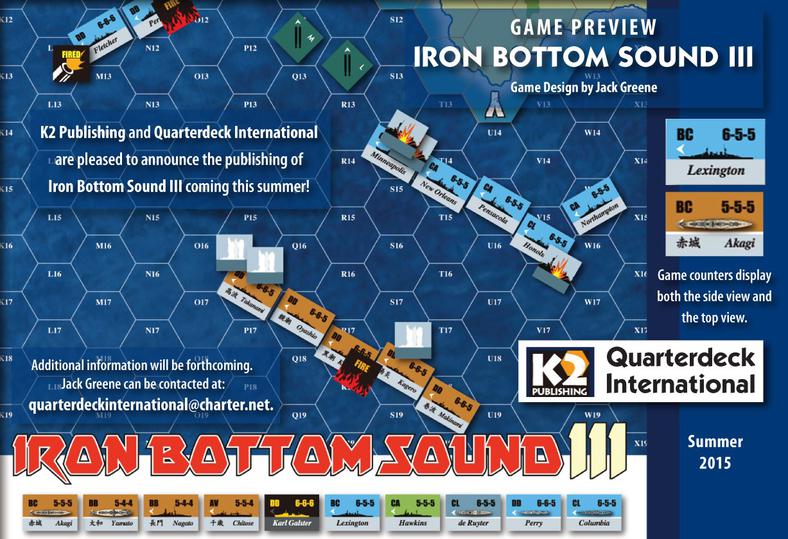
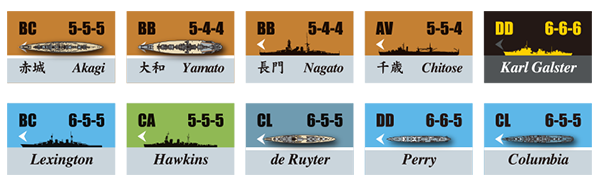
Top 3 Amazing things about Iron Bottom Sound III

Short Rules

I’ve spent years playing monsters like ASL and World in Flames. I’m not afraid of a long rule book and complex rules.  That said, I have been trending more towards shorter, simpler rules these days.  I must admit, I was a little reluctant to take on a game as detailed as Iron Bottom Sound.  I was expecting 60-100 pages of triple column, fine print. 

Amazingly no!  The rule book is only around 30 pages and half of those are scenarios.  Double column.  Big font size.  Easy to read with lots of space.  The actual rules only come in around 15 pages.  The rules make sense so they are easy to remember.  Very clean. 

Written Orders

What?!! How could that be?  Sounds like a mess.  It’s not.  It is amazing.  I love Columbia Games and Kriegsspiel because they bring in hidden and unknown features of war.  This game does the same thing only without umpires and blocks. 

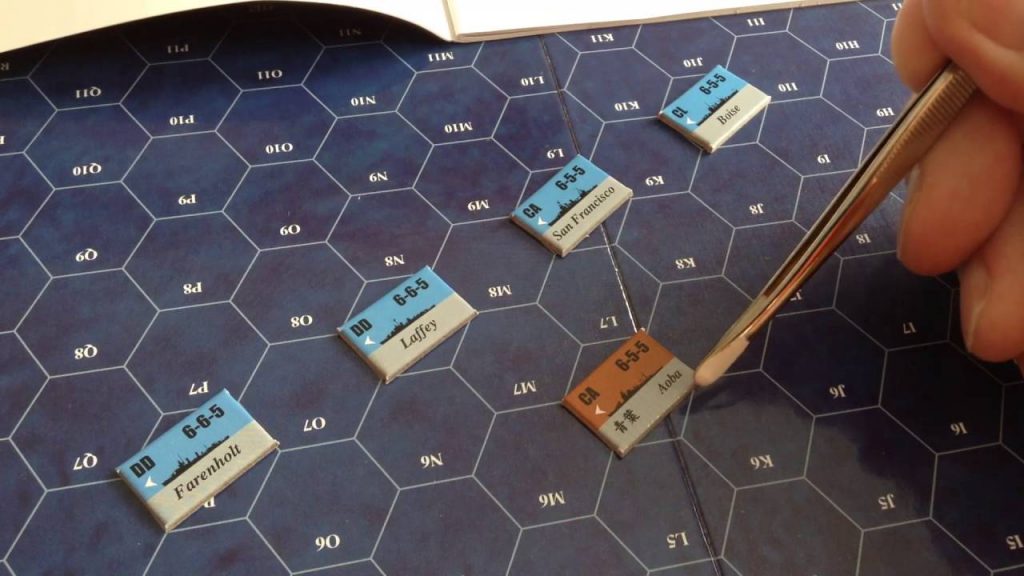
Now at first I thought this sounds like a big hassle. You have to write out where each ship goes?  Who wants to sit around, hand writing orders.  Their system makes it painless, quick and fun.  How does it work?  You ships face hexsides.  Want to just steam dead ahead?  Fine.  How many Movement Factors does you ship have?  Five.  Ok, just write down “5” on your log.  That simple. 

Ok, then how do you turn? Easy.  Let’s say I want to move ahead for 2 hexes, then turn 60 degrees (that is the next hexside) to port and continue.  That would be:  2P3. 

Making a hard 120 deg turn costs an extra MF. So in that case you would write 2PP2.  All stop?  Just write: 0.  How hard it that?

These little order notes are easy to track on each ships log.

Fog-of-War

That’s pretty sleek and painless but still, why bother with all this writing? Because it is incredibly fun and realistic!!  All the ships move simultaneously.  So you have to try to guess what the enemy is going to do.  Where is he going to be?  Where do you want to end up?  Both players try to anticipate this and plan accordingly while writing down there moves. 

What happens when the enemy doesn’t move like you expect? I can easily imagine all sorts of tricks, maneuvers and mishaps.  Be careful because if your ship ends up in a hex with another ship, they can collide!  All the fun of Kriegsspiel without an umpire or teams in a straightforward 2 player game. 


This game is a gem!

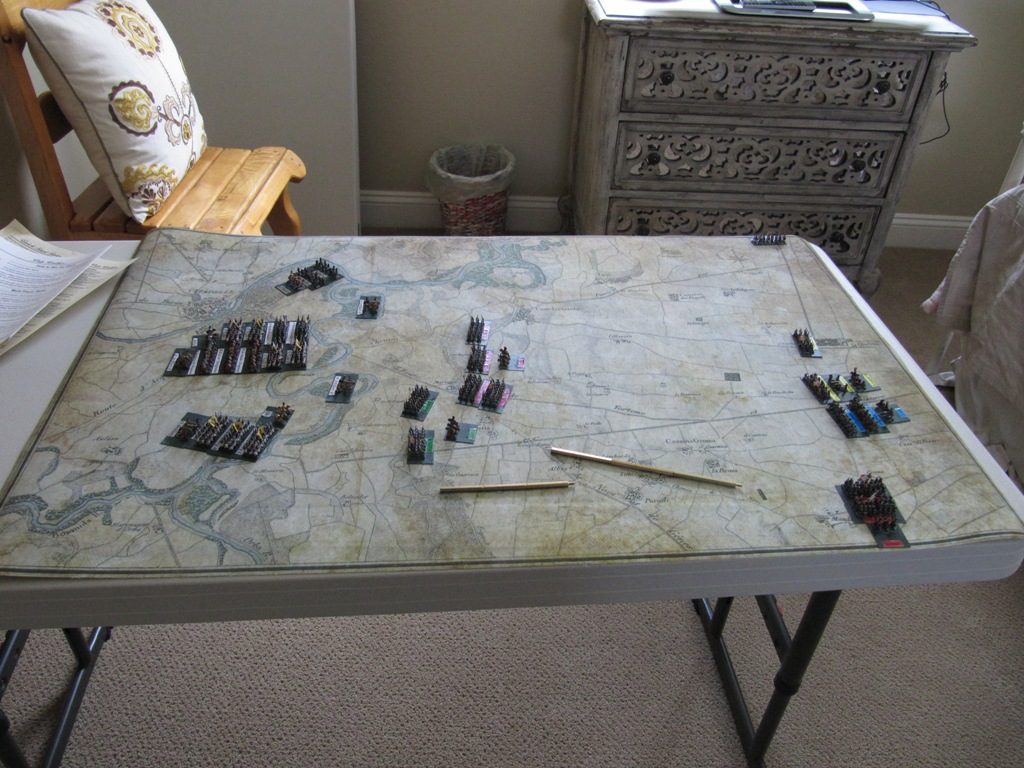
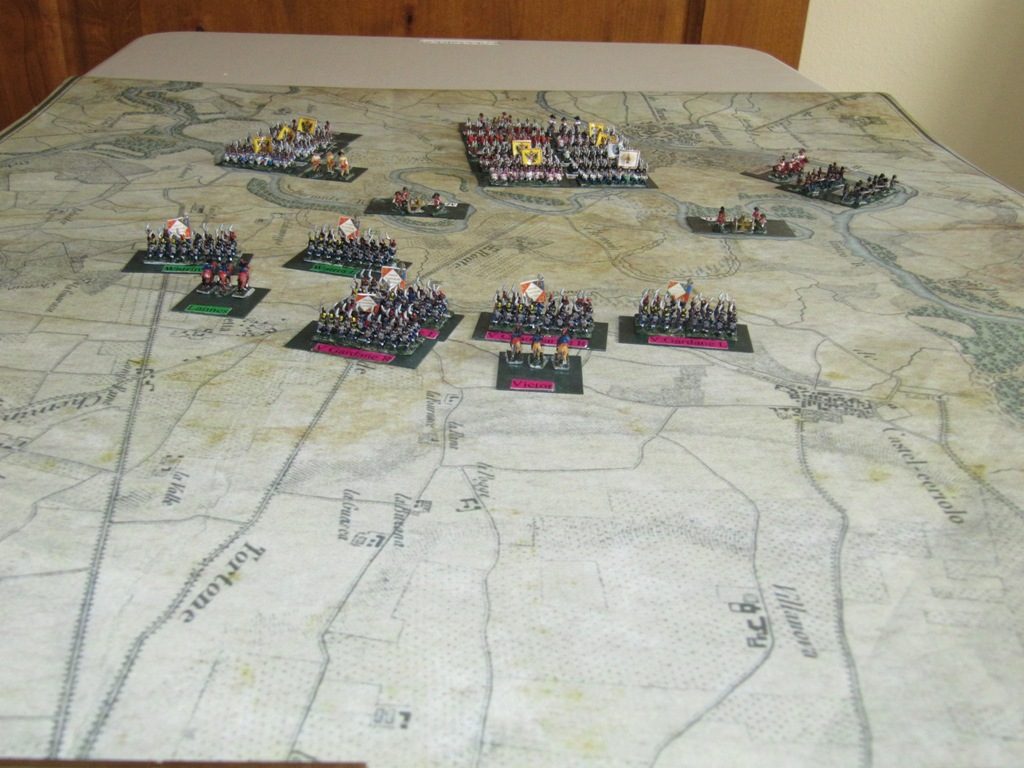
Marengo in Minis

Pub Battles is a mixture between wargame and miniatures.  I’ve been meaning to get set of minis to use for Pub Battles, just to see how they look.  Somebody beat me to it!!

Check it out.  They are all set to Pub Battles scale and everything. 


Austrian Strategy for Marengo

1) You have a 4-1 advantage in artillery. The problem is going to be keeping it up near the front where they can do damage. In many ways, this is one of the biggest weapons of the French: Run! Run fast enough that the Austrian artillery can’t hit you. Starting out, you can deploy your artillery along the river. This does allow you to pound the French right from the get go. The down side is that it will take a turn or two to march them out to the roads and then cross. 


2) Don’t get cocky. Just because you outnumber the French, doesn’t meant this is going to be a cakewalk. Be wary. Especially after the French Cavalry and Guard show up. –Until then, advance as rapidly as possible and push as hard as you can. 


3) Just because the French Cavalry and Guard to show up, doesn’t mean you just sit back and go turtle. You must still attack and be aggressive. You just have to be more… selective. Keep a close eye on the French Cavalry and Guard. You should know where they are at all times. Notice where they are not. In places out of there range, you need to push with your usual zeal. In areas they can reach, be more careful. Always spend the extra time to dress your lines (Rally) before you attack. All of this assumes of course that the French Cav & Guard haven’t moved yet. If they have, then you can be a little more bold. Just keep in mind that they can move first next turn also. 


4) You are going to get ‘out timed’. That is not luck. That is a given. You have to assume the French will get the timing they want. Act accordingly. 


5) If most of your army ends up spent in the opening turns, that’s not a big deal. Late in the game you will want to tidy things up. Try to keep your units organized then. Spent units make easy targets for French charges.

Marengo Errata

We are usually really good about Errata.  We try very hard to keep it to a minimum.  A few last minute changes with Marengo resulted in a few glitches.

The most important is the French reinforcements:

Reinforcements should come in 1 turn later than listed. 

You can find the Errata at the bottom of the Marengo page:  here

Computer Assisted Wargames

Computer games vs board games.  Which is better?  They both have their strengths and weaknesses.  I always like the “idea” of a computer wargame but I usually don’t like them.  All my favorite wargames are board games.


Computers excel at video and live animation graphics.  This is great if you are playing tactical or first person shooter but my favorite games are operational / strategic.

Board game ‘graphics’ win hands down on this.


You can instantly see the entire map.  No zooming or scrolling around.  You can instantly inspect stacks of units and move all the pieces.  No fuss.  I can’t explain it but there is something important about being able to touch and move the pieces by hand.  


Is it possible to marry the two?  Use the best of both formats, combined into 1 system?  It would be ideal if the computer could handle limited intelligence, complex combat, logistics and order delays.

What is your experience with Computer Assisted Wargames?  Does it work?  Have you ever seen an example of it working well?  Is this an impossible pursuit?